Loading…
Dataset · FAO
Prevalence of Severe Food Insecurity
9 years, 2015–2023 · 133 countries
Severe food insecurity is the share of people who ran out of food, or went a whole day without eating, at some point in the year. The FAO gets it by asking them — the Food Insecurity Experience Scale — which makes it the human counterpart to its supply-based undernourishment estimate.
This site holds every year from 2015 to 2023, read from FAO’s own data and stored exactly as published.
Prevalence of Severe Food Insecurity · the file
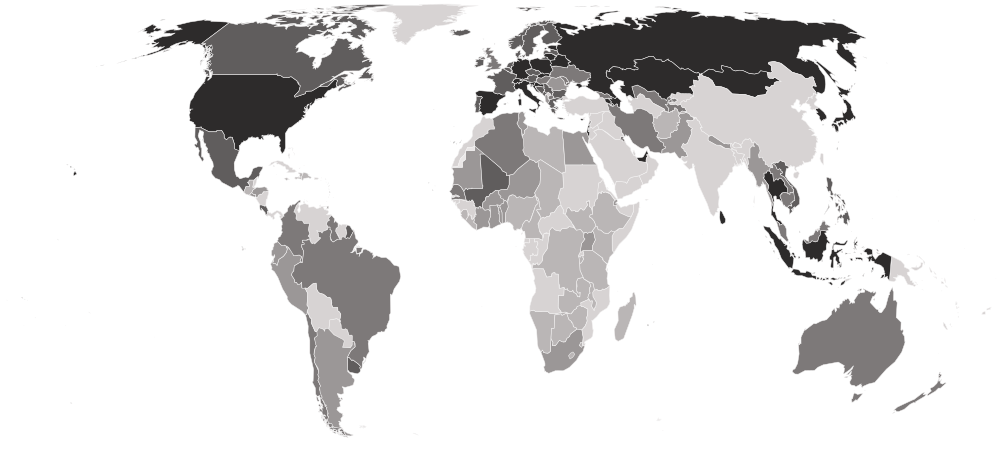
- Newest
- Prevalence of Severe Food Insecurity, 2023
- Held
- 9 years · 1,132 rows
- Licence
- CC BY 4.0
019 years
Every year
Every year comes from FAO’s 2026 release, recalculated on one method. Each opens the full table for that year; each downloads as a CSV.
| Year | Countries | Change | Read | Download |
|---|---|---|---|---|
| Prevalence of Severe Food Insecurity, 2023Newest | 133 | +2 −13 | September 6, 2026 | CSV |
| Prevalence of Severe Food Insecurity, 2022 | 144 | +3 −4 | September 6, 2026 | CSV |
| Prevalence of Severe Food Insecurity, 2021 | 145 | +4 −2 | September 6, 2026 | CSV |
| Prevalence of Severe Food Insecurity, 2020 | 143 | +10 −2 | September 6, 2026 | CSV |
| Prevalence of Severe Food Insecurity, 2019 | 135 | +14 | September 6, 2026 | CSV |
| Prevalence of Severe Food Insecurity, 2018 | 121 | +10 −3 | September 6, 2026 | CSV |
| Prevalence of Severe Food Insecurity, 2017 | 114 | +15 | September 6, 2026 | CSV |
| Prevalence of Severe Food Insecurity, 2016 | 99 | +1 | September 6, 2026 | CSV |
| Prevalence of Severe Food Insecurity, 2015 | 98 | — | September 6, 2026 | CSV |
Every year in one file, one row per country per year: severe-food-insecurity-all-editions-nations-inquiry.csv
023 columns
What’s in the file
Every column, what it holds, how it is stored and what its values look like — what a reader needs before opening the file.
| Column | What it holds | Stored as | Range, 2023 | Distinct | Empty | Spread |
|---|---|---|---|---|---|---|
CountrycountryName | The country’s name, as this file spells it. | Text | — | 133 | 0 | |
ISO Codecountry_codeIdentifier | The ISO 3166-1 alpha-3 code, added by this site. Every table here joins on it. | Text · 3 letters | — | 133 | 0 | |
Population in severe food insecurity (%)severe_food_insecurityHeadline | The headline figure: Population in severe food insecurity (%). | Number · up to 1 decimal | 0.07 share it63.1 South Sudanmiddle 4.7 South Sudanmiddle 4.7 | 91 | 0 |
Profiled from the newest file. Range: the lowest and highest value, with the country holding it when only one does. Spread: countries in ten equal steps from lowest to highest. A higher value is the worse result.
03156 countries across every year
Who is covered
How many countries each year holds, continent by continent, who joined and who left, and which places this site covers that the dataset never has.
| 2015 | 2016 | 2017 | 2018 | 2019 | 2020 | 2021 | 2022 | 2023 | |
|---|---|---|---|---|---|---|---|---|---|
| Africa | 26 | 27 | 33 | 34 | 37 | 42 | 43 | 42 | 39 |
| Americas | 17 | 17 | 19 | 20 | 22 | 25 | 26 | 26 | 21 |
| Asia | 17 | 17 | 22 | 25 | 30 | 30 | 30 | 29 | 29 |
| Europe | 36 | 36 | 36 | 36 | 38 | 38 | 39 | 39 | 39 |
| Oceania | 2 | 2 | 4 | 6 | 8 | 8 | 7 | 8 | 5 |
| All | 98 | 99 | 114 | 121 | 135 | 143 | 145 | 144 | 133 |
Who joined and who left
- 2023
 + United Arab Emirates
 + Cyprus
 − Bahamas
 − Barbados
 − Central African Republic
 − Dominica
 − Fiji
 − Guinea-Bissau
 − Kyrgyzstan
 − Maldives
 − Nauru
 − Paraguay
 − São Tomé and Príncipe
 − Suriname
 − Tonga
 - 2022
 + Burundi
 + Palau
 + Trinidad and Tobago
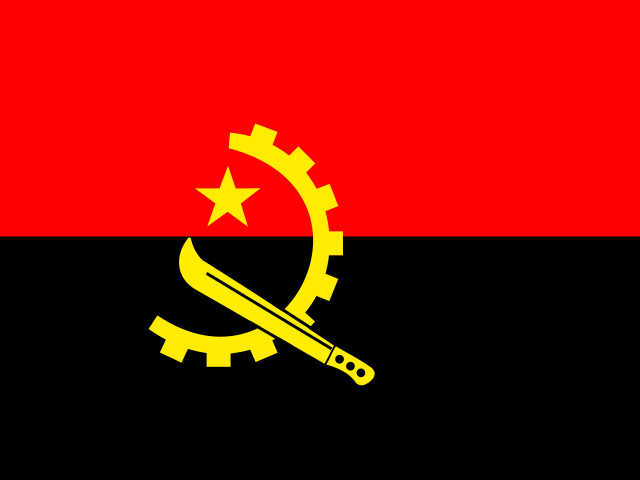 − Angola
 − Belize
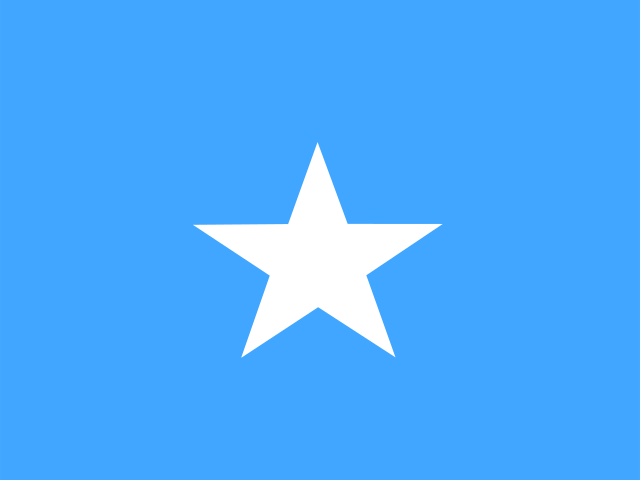 − Somalia
 − Timor-Leste
 - 2021
 + Antigua and Barbuda
 + Guyana
 + Italy+ Somalia
 − Saint Kitts and Nevis
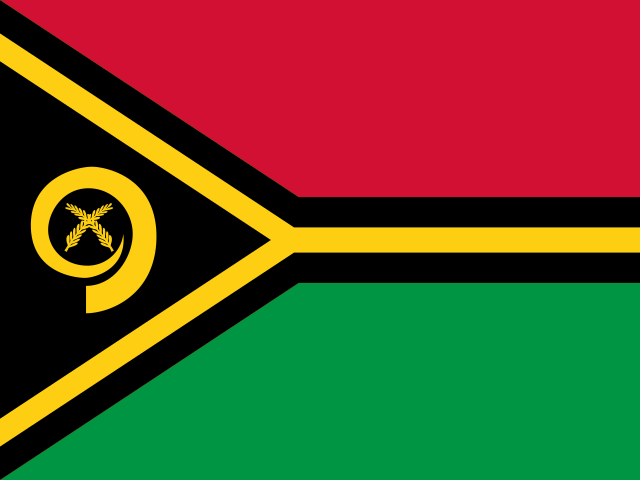 − Vanuatu
 - 2020+ Bahamas+ Barbados+ Central African Republic
 + Comoros
 + Djibouti+ Dominica+ Nauru+ São Tomé and Príncipe+ Suriname
 + Eswatini
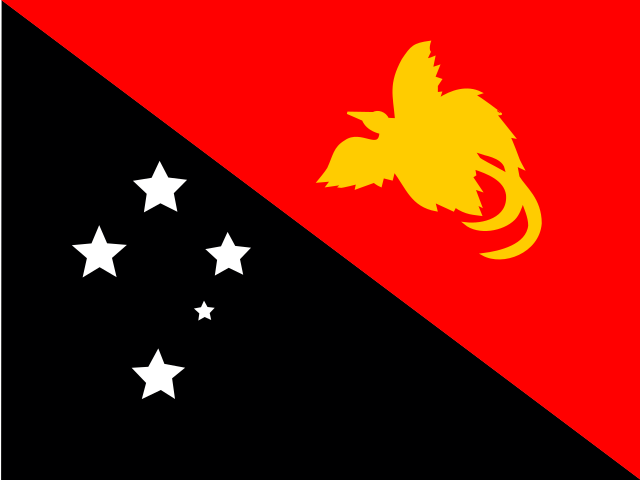 − Papua New Guinea
 − Saint Vincent and the Grenadines
 - 2019+ Angola
 + Belgium
 + Belarus+ Belize
 + DR Congo+ Fiji
 + Haiti
 + Laos
 + Liberia+ Maldives
 + Myanmar
 + Mongolia+ Timor-Leste+ Tonga
 - 2018
 + Kiribati+ Saint Kitts and Nevis
 + Lebanon
 + Lesotho
 + Madagascar
 + Philippines
 + Thailand
 + Uruguay+ Vanuatu
 + South Africa− Liberia
 − Saint Lucia
 − Seychelles
 - 2017
 + Armenia
 + Burkina Faso
 + Cabo Verde+ Guinea-Bissau
 + Grenada
 + Kazakhstan+ Kyrgyzstan
 + Mali
 + Niger+ Papua New Guinea
 + Palestine+ South Sudan+ Saint Vincent and the Grenadines
 + Vietnam
 + Samoa
 - 2016
 + Gambia
Not in this dataset · 68 places this site covers
FAO gives no figure for these in any year held here. It is the publisher’s choice of scope, and each place’s profile shows what is measured.
 American Samoa
 Andorra
 Anguilla
 Aruba
Aruba Bahrain
 Bangladesh
 Bermuda
 Bhutan
 Bolivia
 British Virgin Islands
 Brunei
 Cayman IslandsChannel Islands
 China
China Cook Islands
 Cuba
Cuba Curaçao
 Equatorial Guinea
 Eritrea
 Faroe Islands
 French Polynesia
 Gabon
Gabon Gibraltar
 Greenland
 Guam
Guam Guinea
 Hong Kong
 India
India Iraq
Iraq Isle of Man
 Jordan
 Kosovo
 Liechtenstein
 Macau
Macau Marshall Islands
 Micronesia
 Monaco
 Montserrat
 Morocco
 Mozambique
 New Caledonia
 Nicaragua
 Niue
Niue North Korea
 Northern Mariana Islands
 Oman
Oman Panama
 Puerto Rico
 Qatar
Qatar Republic of the Congo
 Rwanda
 Saint Martin
 San Marino
 Saudi Arabia
 Sint Maarten
 Solomon IslandsSomaliland
 Sudan
Sudan Syria
Syria Taiwan
 Türkiye
 Turkmenistan
 Turks and Caicos Islands
 Tuvalu
 United States Virgin Islands
 Vatican City
 Venezuela
 Yemen
Yemen04Provenance
Where it comes from
The path from the publisher to this page, and what was checked and changed on the way.
1 · Publisher
Food and Agriculture Organization of the United Nations (FAO)
2 · Their file
Prevalence of Severe Food Insecurity 2023
3 · Read by this site
September 6, 2026
Imported by a script that parses each figure and writes it down unrounded.4 · Stored as
9 files, one per year
Each downloads as a CSV, or every year together as severe-food-insecurity-all-editions-nations-inquiry.csv5 · Used on
Its statistic page, and every profile it measures
/statistics/severe-food-insecurityA key for Health & Wellbeing in the Country Index.
Precision
The headline is stored to 1 decimal, as published.
Rounded by this site
Never. Tables on screen may show fewer decimals; the files never do.
Changed by this site
Reshaped into one row per country: regional and income-group totals are left out, only the columns listed are kept, each row gets its ISO 3166 code, and some country names are brought to one spelling. No value is recalculated, rescaled or rounded.
From the FAO’s Food Insecurity Experience Scale via the World Bank’s indicator API (SN.ITK.SVFI.ZS). Coverage is partial and uneven — a country absent from an edition was not surveyed, which is not the same as having no hunger.
05Reuse
Licence and credit
What the publisher’s licence lets you do, what it asks of you, and a credit line and citation ready to copy.
Licence · checked September 6, 2026
- Share and redistribute it
- Adapt it and build on it
- Use it commercially
- Credit the publisher
- Say what you changed
Share, adapt and use commercially. Credit the publisher and say if you changed anything.
A credit line
Source: Food and Agriculture Organization of the United Nations (FAO), Prevalence of Severe Food Insecurity, via Nations Inquiry.
Cite this dataset
Food and Agriculture Organization of the United Nations (FAO). Prevalence of Severe Food Insecurity, 2015–2023 [data set]. As held by Nations Inquiry, https://nationsinquiry.com/datasets/severe-food-insecurity
The publisher’s own citation: Food and Agriculture Organization of the United Nations. FAOSTAT. Rome: FAO.
Plain-language summary, not legal advice. The licence text is what binds.
06Where it is used
Around the site
Where these numbers appear on this site, and the datasets nearest to it.
Charted
Prevalence of Severe Food Insecurity by countryWho is highest, the map, the spread, who rose and fell, and the records.
In the Country Index
A key for Health & Wellbeing
“The share of people who went without food, established by asking them rather than by modelling the supply.”
Health & Wellbeing standingsSubjects
Near neighbours
- Life Expectancy at BirthUN DESA Population Division · 74 held · 1950–2023
- Under-Five Mortality RateUN IGME · 73 held · 1952–2024
- Human Development IndexUNDP Human Development Report Office · 34 held · 1990–2023

07Questions
Prevalence of Severe Food Insecurity: questions and answers
What is the Prevalence of Severe Food Insecurity?
Severe food insecurity is the share of people who ran out of food, or went a whole day without eating, at some point in the year. The FAO gets it by asking them — the Food Insecurity Experience Scale — which makes it the human counterpart to its supply-based undernourishment estimate.
Which years of the Prevalence of Severe Food Insecurity can I download?
All 9, from 2015 to 2023, each as a CSV file, or every year together in one CSV.
Does FAO rank countries on it?
No. FAO publishes values only. The positions shown on this site are derived by ordering the published values, and are labelled as ours.
Can I use it commercially?
Yes, under CC BY 4.0, with credit to FAO. The licence text is linked on this page.