Loading…
Topic 08 of 18 · Country Index 2026
Gender & Equality
How wide is the gap between women's and men's lives?
Latvia is placed first of 183 countries on gender & equality in the Country Index 2026, and Yemen 183rd. The standing rests on 4 key statistics; the other 11 on this page are published as context, with no vote.
08
4 key statistics
01Country Index 2026
Who leads on gender & equality
The three countries placed highest of 183, the three placed lowest, and the country placed highest on each continent. Each position is a place in this topic’s own list, built from its key statistics.
 1
1 Latvia
Northern Europe
1st of 183 · 4 of 4 keys
Photo: Marcin Szala · CC BY-SA 3.0, greyscale
 2
2 Taiwan
Eastern Asia
2nd of 183 · 3 of 4 keys
Photo: xiangyang17 · CC BY-SA 2.0, greyscale
 3
3 Italy
ItalySouthern Europe
3rd of 183 · 4 of 4 keys
Photo: Francisco Antunes · CC BY 2.0, greyscale
Placed lowest on Gender & Equality
Positions out of 183. A standing is relative: it says where a country places against the others measured, not that it scored zero.
Placed first on each continent · position among all 183
02The subject
About gender & equality
The distance between women's and men's lives, measured two different ways: the gap in real outcomes across work, education, health and political power, and the gap written into law. A country can grant full legal parity and still show a wide outcome gap, so a score here is only read properly with both.
Gender equality is measured three ways here, because the gap has three places to live. It lives in outcomes: how much political power women actually hold, and how many of them run the businesses they work in. It lives in law: whether the statute book treats women and men the same in work, pay, marriage and property. And it lives in custom: the social norms and institutions that shape what women can do regardless of what the law says.
The three often disagree. A country can remove discrimination from its laws while outcomes lag for a generation, or keep unequal laws on the books that custom has quietly moved past. A standing here is only read properly with all three in view.
What this topic does not measure
Violence against women is not a key here, because comparable data covers too few countries. The Gender Inequality Index is published here as context rather than as a key: its reading is driven largely by maternal and adolescent health, which moves with a country’s overall development and is already measured under Development and Health. Women’s labour force participation, women in management and child marriage are published here as context too.
03The evidence
The 4 statistics that decide it
These are the only statistics that place countries on gender & equality — one vote each. Every number is somebody else’s research, reproduced without adjustment; the ordering on top is this site’s.
Key 1 of 4
Women, Business and the Law
World Bank Group
Why it is a key: The gap written into the statute book, which a country can close while outcomes lag for a generation.
- Edition used
- 2024data for 2024
- Countries
- 190
- Publisher’s rank
- None — values only
- Licence
- CC BY 4.0
Key 2 of 4
Firms with a Female Top Manager
World Bank Group
Why it is a key: The share of firms whose top manager is a woman: economic power held, beside the political power and the legal and social rules the other keys in this subject measure.
- Edition used
- 2025data for 2025
- Countries
- 170
- Publisher’s rank
- None — values only
- Licence
- CC BY 4.0
Every country, every editionCurrent leader, 2025 edition
 Kiribati
Key 3 of 4
Women's Political Empowerment Index
V-Dem Institute, University of Gothenburg
Why it is a key: Political power held by women in practice — their civil liberties, their part in civil society and their share of political office — where the law and custom keys measure the rules they live under.
- Edition used
- 2025data for 2025
- Countries
- 176
- Publisher’s rank
- None — values only
- Licence
- CC BY-SA 4.0
Every country, every editionCurrent leader, 2025 edition
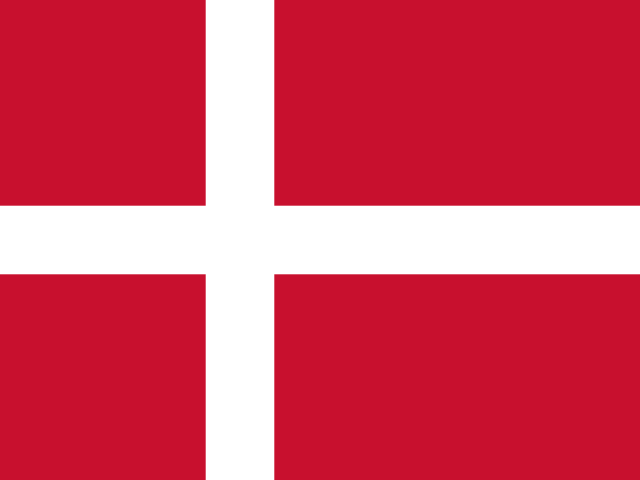 Denmark
Key 4 of 4
Social Institutions and Gender Index
OECD
Why it is a key: Discrimination in social institutions and norms. Correlates 0.850 with Women, Business and the Law, inside the 0.92 bar, and kept because law and custom diverge widely.
- Edition used
- 2023data for 2023
- Countries
- 140
- Publisher’s rank
- None — values only
- Licence
- OECD Terms and Conditions — data clause
Every country, every editionMost affected, 2023 edition
 Mauritania
How the keys combine
Each country’s value on each key becomes its place in that key’s own field, as a share of the field. The shares are averaged, one vote per key, and only the order that produces is published.
The method in full
04Every placed country
Gender & Equality on a map
Darker is placed higher. Hover a country for its position, or select it to open its page. Below the map, each continent’s median position — half its placed countries sit at or above it, so lower is better.
1st183rdNot placed · 41 countries with too few key statisticsNo data
1st of 5 continents
Europe
26th
median position, of 183 · 40 of its 49 countries placed
Highest
Latvia2nd of 5 continents
Americas
65th
median position, of 183 · 31 of its 48 countries placed
Highest
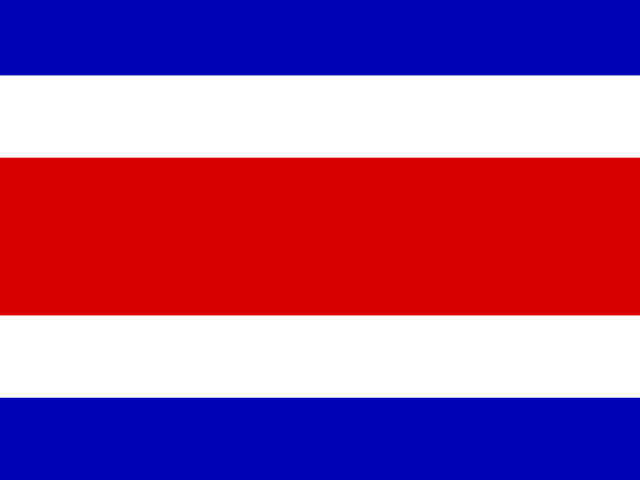 Costa Rica
3rd of 5 continents
Oceania
99th
median position, of 183 · 9 of its 21 countries placed
Highest
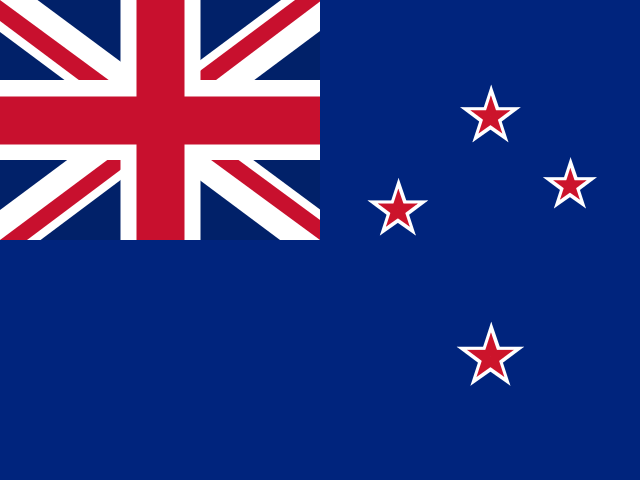 New Zealand
4th of 5 continents
Africa
127th
median position, of 183 · 54 of its 55 countries placed
Highest
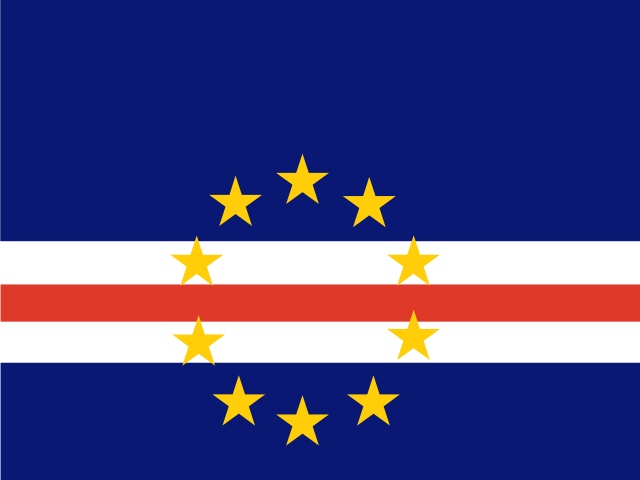 Cabo Verde
5th of 5 continents
Asia
132nd
median position, of 183 · 49 of its 52 countries placed
Highest
Taiwan- Every region
All 21 sub-regions on Gender & Equality, best median first
- 1Australia and New Zealandmedian 9thfrom 2 of 2New Zealand9
- 2Northern Europemedian 17thfrom 10 of 13Latvia1
- 3Western Europemedian 18thfrom 7 of 9
 Belgium6
 - 4Northern Americamedian 20thfrom 2 of 4
 Canada20
 - 5Eastern Asiamedian 28thfrom 6 of 8Taiwan2
- 6Southern Europemedian 29thfrom 13 of 17Italy3
- 7Eastern Europemedian 38thfrom 10 of 10
 Poland=12
 - 8Polynesiamedian 55thfrom 2 of 7
 Samoa55
 - 9South Americamedian 61stfrom 12 of 12
 Bolivia34
 - 10Central Americamedian 72ndfrom 8 of 8Costa Rica4
- 11Caribbeanmedian 73rdfrom 9 of 24
 Jamaica37
 - 12Southern Africamedian 79thfrom 5 of 5
 South Africa39
 - 13South-eastern Asiamedian 94thfrom 11 of 11
 Timor-Leste=49
 - 14Melanesiamedian 102ndfrom 4 of 5
 Fiji100
 - 15Eastern Africamedian 108thfrom 18 of 19
 Seychelles48
 - 16Western Africamedian 120thfrom 16 of 16Cabo Verde=35
- 17Central Asiamedian 133rdfrom 5 of 5
 Kazakhstan=90
 - 18Middle Africamedian 141stfrom 9 of 9
 São Tomé and Príncipe52
 - 19Southern Asiamedian 151stfrom 9 of 9
 Bhutan=123
 - 20Northern Africamedian 159thfrom 6 of 6
 Tunisia145
 - 21Western Asiamedian 161stfrom 18 of 19
 Armenia=35
05The whole field
Where all 183 countries stand
In order, best first. A row resting on fewer keys rests on less evidence: a country needs 2 of the 4 to be placed at all. “=” marks a position shared with another country. Select a country to see the working behind its standing.
Showing 25 of 183 countries placed on Gender & Equality
- 1 of 183LatviaNorthern Europe4/4
- 2 of 183TaiwanEastern Asia3/4
- 3 of 183ItalySouthern Europe4/4
- 4 of 183Costa RicaCentral America4/4
- 5 of 183
 LithuaniaNorthern Europe4/4
 - 6 of 183BelgiumWestern Europe4/4
- 7 of 183
 SloveniaSouthern Europe4/4
 - 8 of 183
 CroatiaSouthern Europe4/4
 - 9 of 183New ZealandAustralia and New Zealand4/4
- 10 of 183
 FranceWestern Europe4/4
 - 11 of 183
 NorwayNorthern Europe4/4
 - =12 of 183PolandEastern Europe4/4
- =12 of 183
 SpainSouthern Europe4/4
 - 14 of 183
 AustriaWestern Europe4/4
 - 15 of 183
 MoldovaEastern Europe4/4
 - 16 of 183
 SwedenNorthern Europe4/4
 - 17 of 183
 FinlandNorthern Europe4/4
 - 18 of 183
 GermanyWestern Europe4/4
 - 19 of 183
 EstoniaNorthern Europe4/4
 - 20 of 183CanadaNorthern America4/4
- 21 of 183
 IrelandNorthern Europe4/4
 - 22 of 183
 South KoreaEastern Asia4/4
 - 23 of 183
 AustraliaAustralia and New Zealand4/4
 - 24 of 183
 AlbaniaSouthern Europe4/4
 - 25 of 183
 BulgariaEastern Europe4/4
 - =26 of 183
 NetherlandsWestern Europe4/4
 - =26 of 183
 PortugalSouthern Europe4/4
 - 28 of 183
 MongoliaEastern Asia4/4
 - 29 of 183
 SerbiaSouthern Europe4/4
 - 30 of 183
 SwitzerlandWestern Europe4/4
 - 31 of 183DenmarkNorthern Europe4/4
- 32 of 183
 IcelandNorthern Europe3/4
 - 33 of 183
 CzechiaEastern Europe4/4
 - 34 of 183BoliviaSouth America4/4
- =35 of 183ArmeniaWestern Asia4/4
- =35 of 183Cabo VerdeWestern Africa3/4
- 37 of 183JamaicaCaribbean4/4
- 38 of 183
 SlovakiaEastern Europe4/4
 - 39 of 183South AfricaSouthern Africa4/4
- 40 of 183
 GreeceSouthern Europe4/4
 - =41 of 183
 Hong KongEastern Asia4/4
 - =41 of 183
 United StatesNorthern America4/4
 - 43 of 183
 Saint LuciaCaribbean2/4
 - =44 of 183
 BelizeCentral America3/4
 - =44 of 183
 United KingdomNorthern Europe4/4
 - 46 of 183
 RomaniaEastern Europe4/4
 - 47 of 183KiribatiMicronesia2/4
- 48 of 183SeychellesEastern Africa3/4
- =49 of 183
 PeruSouth America4/4
 - =49 of 183Timor-LesteSouth-eastern Asia3/4
- 51 of 183
 HungaryEastern Europe4/4
 - 52 of 183São Tomé and PríncipeMiddle Africa3/4
- 53 of 183
 GrenadaCaribbean2/4
 - 54 of 183
 Dominican RepublicCaribbean4/4
 - 55 of 183SamoaPolynesia2/4
- =56 of 183
 UkraineEastern Europe4/4
 - =56 of 183
 UruguaySouth America4/4
 - 58 of 183
 EcuadorSouth America4/4
 - 59 of 183
 RwandaEastern Africa4/4
 - 60 of 183
 SurinameSouth America3/4
 - 61 of 183
 GuyanaSouth America2/4
 - 62 of 183
 MaltaSouthern Europe4/4
 - =63 of 183
 BrazilSouth America4/4
 - =63 of 183
 MontenegroSouthern Europe4/4
 - 65 of 183
 PanamaCentral America4/4
 - 66 of 183
 LuxembourgWestern Europe3/4
 - 67 of 183
 VenezuelaSouth America3/4
 - 68 of 183
 BeninWestern Africa4/4
 - 69 of 183
 NamibiaSouthern Africa4/4
 - 70 of 183
 MauritiusEastern Africa3/4
 - 71 of 183
 ColombiaSouth America4/4
 - 72 of 183
 El SalvadorCentral America4/4
 - 73 of 183
 Antigua and BarbudaCaribbean2/4
 - 74 of 183
 GabonMiddle Africa4/4
 - =75 of 183
 GeorgiaWestern Asia4/4
 - =75 of 183
 Trinidad and TobagoCaribbean4/4
 - 77 of 183
 CyprusWestern Asia3/4
 - 78 of 183
 VietnamSouth-eastern Asia4/4
 - =79 of 183
 LaosSouth-eastern Asia4/4
 - =79 of 183
 LesothoSouthern Africa4/4
 - 81 of 183
 ParaguaySouth America4/4
 - 82 of 183
 BarbadosCaribbean3/4
 - 83 of 183
 North MacedoniaSouthern Europe4/4
 - 84 of 183
 Côte d’IvoireWestern Africa4/4
 - 85 of 183
 ZimbabweEastern Africa4/4
 - 86 of 183
 ChileSouth America4/4
 - =87 of 183
 MexicoCentral America4/4
 - =87 of 183
 NicaraguaCentral America4/4
 - 89 of 183
 MozambiqueEastern Africa4/4
 - =90 of 183
 HondurasCentral America4/4
 - =90 of 183KazakhstanCentral Asia4/4
- 92 of 183
 CambodiaSouth-eastern Asia4/4
 - 93 of 183
 PhilippinesSouth-eastern Asia4/4
 - =94 of 183
 BruneiSouth-eastern Asia2/4
 - =94 of 183
 ThailandSouth-eastern Asia4/4
 - =96 of 183
 Bosnia and HerzegovinaSouthern Europe4/4
 - =96 of 183
 KosovoSouthern Europe4/4
 - =96 of 183
 LiberiaWestern Africa4/4
 - 99 of 183
 TongaPolynesia2/4
 - 100 of 183FijiMelanesia3/4
- 101 of 183
 UgandaEastern Africa4/4
 - 102 of 183
 VanuatuMelanesia3/4
 - 103 of 183
 ArgentinaSouth America4/4
 - 104 of 183
 KenyaEastern Africa4/4
 - 105 of 183
 SingaporeSouth-eastern Asia4/4
 - 106 of 183
 ZambiaEastern Africa4/4
 - 107 of 183
 KyrgyzstanCentral Asia4/4
 - 108 of 183
 DjiboutiEastern Africa3/4
 - 109 of 183
 TogoWestern Africa4/4
 - 110 of 183
 GuatemalaCentral America4/4
 - 111 of 183
 Sierra LeoneWestern Africa4/4
 - 112 of 183
 IndonesiaSouth-eastern Asia4/4
 - 113 of 183
 MadagascarEastern Africa4/4
 - 114 of 183
 TanzaniaEastern Africa4/4
 - 115 of 183
 Saint Vincent and the GrenadinesCaribbean2/4
 - 116 of 183
 IsraelWestern Asia4/4
 - 117 of 183
 BelarusEastern Europe3/4
 - 118 of 183
 JapanEastern Asia4/4
 - 119 of 183
 GhanaWestern Africa4/4
 - 120 of 183
 SenegalWestern Africa4/4
 - 121 of 183
 BotswanaSouthern Africa4/4
 - 122 of 183
 RussiaEastern Europe3/4
 - =123 of 183BhutanSouthern Asia4/4
- =123 of 183
 ChinaEastern Asia4/4
 - =125 of 183
 AngolaMiddle Africa4/4
 - =125 of 183
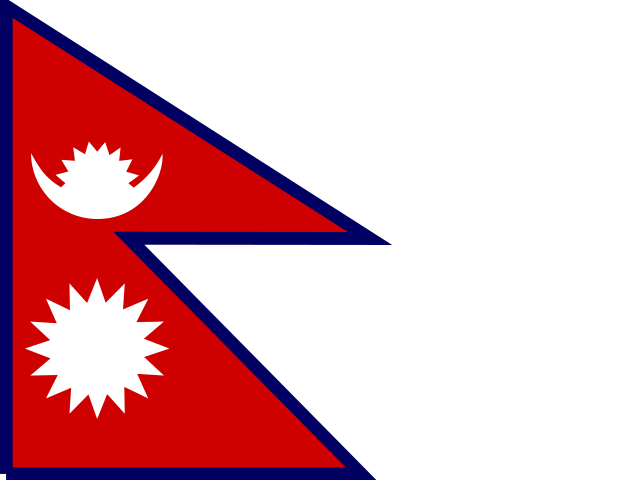 NepalSouthern Asia4/4
 - =127 of 183
 MalawiEastern Africa4/4
 - =127 of 183
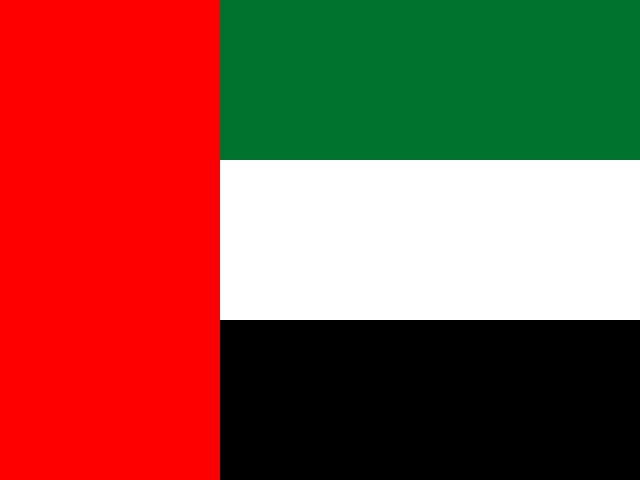 United Arab EmiratesWestern Asia2/4
 - 129 of 183
 EthiopiaEastern Africa4/4
 - 130 of 183
 Burkina FasoWestern Africa4/4
 - 131 of 183
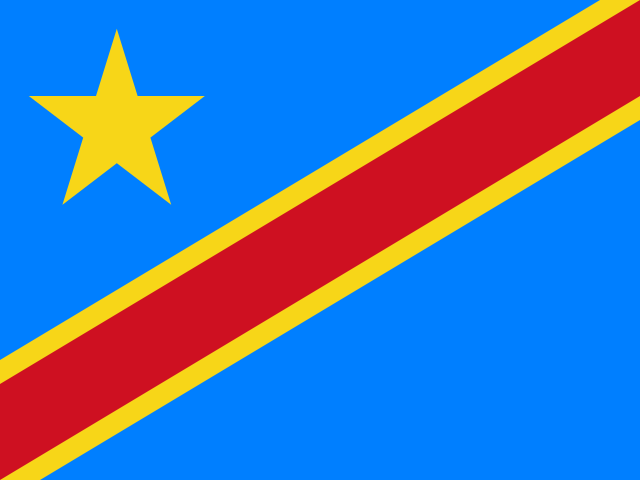 DR CongoMiddle Africa4/4
 - 132 of 183
 MalaysiaSouth-eastern Asia4/4
 - 133 of 183
 UzbekistanCentral Asia3/4
 - 134 of 183
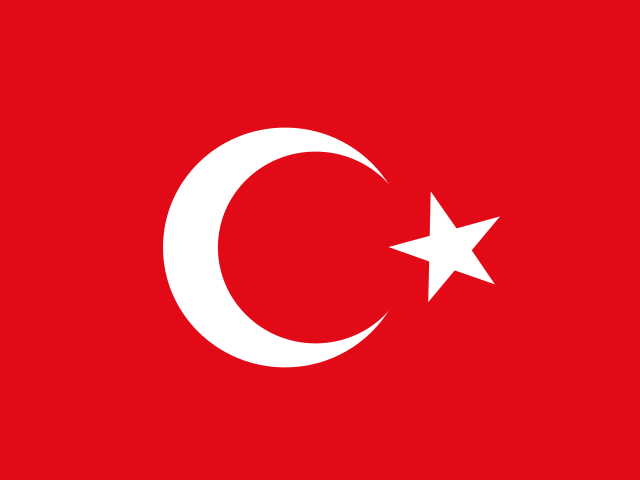 TürkiyeWestern Asia4/4
 - 135 of 183
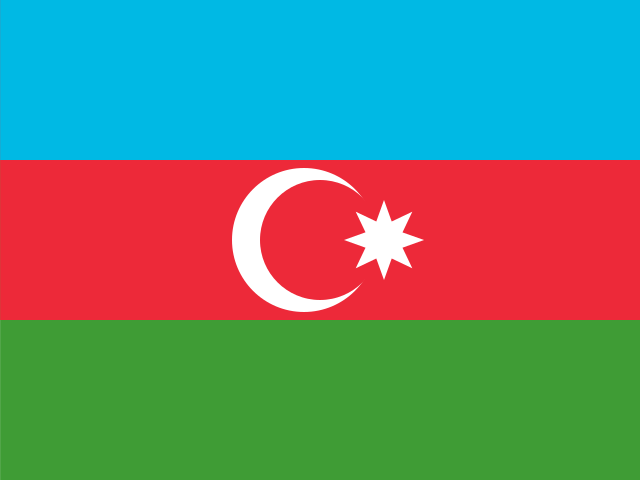 AzerbaijanWestern Asia4/4
 - 136 of 183
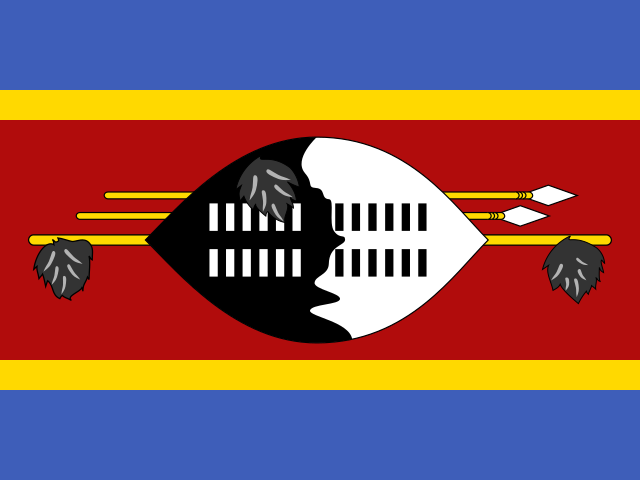 EswatiniSouthern Africa3/4
 - 137 of 183
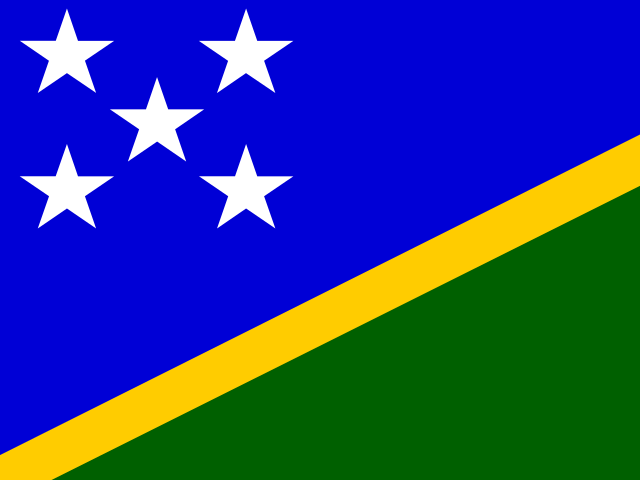 Solomon IslandsMelanesia3/4
 - 138 of 183
 MyanmarSouth-eastern Asia4/4
 - 139 of 183
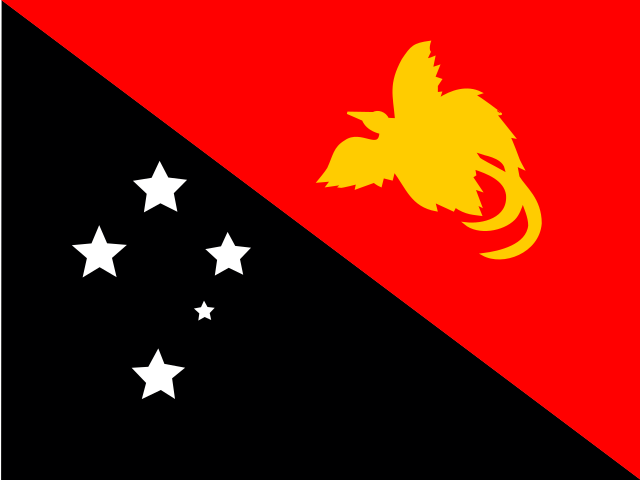 Papua New GuineaMelanesia3/4
 - 140 of 183
 NigeriaWestern Africa4/4
 - 141 of 183
 CameroonMiddle Africa4/4
 - 142 of 183
 GambiaWestern Africa4/4
 - 143 of 183
 BurundiEastern Africa4/4
 - 144 of 183
 ComorosEastern Africa4/4
 - 145 of 183TunisiaNorthern Africa4/4
- 146 of 183
 Republic of the CongoMiddle Africa3/4
 - 147 of 183
 MoroccoNorthern Africa4/4
 - 148 of 183
 Central African RepublicMiddle Africa4/4
 - 149 of 183
 MaldivesSouthern Asia3/4
 - 150 of 183
 IndiaSouthern Asia4/4
 - 151 of 183
 Sri LankaSouthern Asia4/4
 - 152 of 183
 TajikistanCentral Asia4/4
 - 153 of 183
 NigerWestern Africa4/4
 - 154 of 183
 ChadMiddle Africa4/4
 - 155 of 183
 GuineaWestern Africa4/4
 - 156 of 183
 South SudanEastern Africa4/4
 - 157 of 183
 BahrainWestern Asia3/4
 - 158 of 183
 MaliWestern Africa4/4
 - 159 of 183
 AlgeriaNorthern Africa2/4
 - 160 of 183
 HaitiCaribbean3/4
 - 161 of 183
 JordanWestern Asia4/4
 - 162 of 183
 LebanonWestern Asia4/4
 - 163 of 183
 EritreaEastern Africa2/4
 - 164 of 183MauritaniaWestern Africa4/4
- 165 of 183
 Equatorial GuineaMiddle Africa3/4
 - 166 of 183
 EgyptNorthern Africa4/4
 - 167 of 183
 BangladeshSouthern Asia4/4
 - 168 of 183
 Guinea-BissauWestern Africa3/4
 - 169 of 183
 Saudi ArabiaWestern Asia4/4
 - 170 of 183
 PakistanSouthern Asia4/4
 - 171 of 183
 SomaliaEastern Africa4/4
 - 172 of 183
 TurkmenistanCentral Asia2/4
 - 173 of 183
 LibyaNorthern Africa2/4
 - 174 of 183
 IraqWestern Asia4/4
 - 175 of 183
 AfghanistanSouthern Asia3/4
 - 176 of 183
 OmanWestern Asia2/4
 - 177 of 183
 PalestineWestern Asia3/4
 - 178 of 183
 KuwaitWestern Asia3/4
 - 179 of 183
 QatarWestern Asia4/4
 - 180 of 183
 SyriaWestern Asia2/4
 - 181 of 183
 IranSouthern Asia3/4
 - 182 of 183
 SudanNorthern Africa3/4
 - 183 of 183
 YemenWestern Asia2/4
41 countries measured in the index but not placed on gender & equality
Each holds readings on too few of this topic’s key statistics to be placed. Their profiles still show every reading the publishers give.
- American Samoa
- Andorra
- Anguilla
- Aruba
- Bahamas
- Bermuda
- British Virgin Islands
- Cayman Islands
- Channel Islands
- Cook Islands
- Cuba
- Curaçao
- Dominica
- Faroe Islands
- French Polynesia
- Gibraltar
- Greenland
- Guam
- Isle of Man
- Liechtenstein
- Macau
- Marshall Islands
- Micronesia
- Monaco
- Montserrat
- Nauru
- New Caledonia
- Niue
- North Korea
- Northern Mariana Islands
- Palau
- Puerto Rico
- Saint Kitts and Nevis
- Saint Martin
- San Marino
- Sint Maarten
- Somaliland
- Turks and Caicos Islands
- Tuvalu
- United States Virgin Islands
- Vatican City
06Beyond the headline
A different story
The countries placed furthest above and below their overall position in the Country Index 2026. Both positions are compared as a share of their own field, because 50th of 193 and 50th of 174 are not the same showing.
Placed higher on Gender & Equality than overall
07In records
Gender in records
One country at the extreme of a statistic under this topic, read from its newest edition. Where countries tie at the top, no record is named.
Least discrimination in social institutions
6.7
on the OECD’s SIGI, where 0 is none
Lowest gender inequality
0.003
on UNDP’s 0–1 index
08Latest editions
Who rose and fell in the published ranks
The biggest moves between each report’s two newest editions, in the publisher’s own ranks — reports under this topic that print a rank. A report whose field changed by more than 5% is left out.
Ranks as published by UNDP Human Development Report Office in the Gender Inequality Index: reference years 2022 (172 countries ranked) → 2023 (172 ranked), both from its 2025 report.
Improved most
rank before → after- Benin166 → 153+13
- Sierra Leone162 → 152+10
- Tonga122 → 115+7
09Context, no vote
Also measured under gender & equality
11 more statistics on the same subject, published in full and deliberately given no vote — keeping them out is what stops the standing drifting toward whichever kind of statistic was imported most. Select a row for its leader and trend.
Maternal Mortality RatioMMEIG · 195 countries · 2023MMEIG1952023
Most affected:
NigeriaUN Maternal Mortality Estimation Inter-Agency Group (MMEIG) · 24 editions, data 2000–2023
Gender Development IndexUNDP Human Development Report Office · 184 countries · 2023UNDP Human Development Report Office1842023
Current leader:
UkraineUNDP Human Development Report Office · 34 editions, data 1990–2023
Female Labour Force Participation RateILO · 182 countries · 2025ILO1822025
Current leader:
MadagascarInternational Labour Organization (ILO) · 36 editions, data 1990–2025
Gender Inequality IndexUNDP Human Development Report Office · 172 countries · 2023UNDP Human Development Report Office1722023
Most affected:
YemenUNDP Human Development Report Office · 34 editions, data 1990–2023
Child MarriageUNICEF · 145 countries · 2025UNICEF1452025
Gender Social Norms IndexUNDP Human Development Report Office · 91 countries · 2023UNDP Human Development Report Office912023
Most affected:
TajikistanUNDP Human Development Report Office · 1 edition
Births Attended by Skilled Health StaffUNICEF · 86 countries · 2019UNICEF862019
UNICEF · 23 editions, data 1995–2019
Female Share of Senior and Middle ManagementILO · 86 countries · 2024ILO862024
Current leader:
 Nauru
NauruInternational Labour Organization (ILO) · 10 editions, data 2014–2024
Female Genital Mutilation PrevalenceUNICEF · 31 countries · 2024UNICEF312024
Describing the shape of a country (2)
These have no better end — more is not better or worse, only different — so they could not place countries even as keys.
Sex Ratio at BirthUN DESA Population Division · 222 countries · 2023UN DESA Population Division2222023
Highest:
 Liechtenstein
UN DESA Population Division · 74 editions, data 1950–2023
Female Share of ResearchersUIS · 153 countries · 2024UIS1532024
Highest:
MyanmarUNESCO Institute for Statistics (UIS) · 1 edition
10Keep reading
Explore further
The most-read profiles, on Gender & Equality
How Gender & Equality relates to the other topics
- Moves most with: Democracy & Civil LibertiesCountries place similarly on both. (0.76, 183 countries)
- Moves most with: Governance & InstitutionsCountries place similarly on both. (0.69, 183 countries)
- Moves least with: Environment & SustainabilityCountries placed high on one tend to place low on the other. (-0.25, 176 countries)
Rank correlation of the two topics’ positions across the countries placed on both: 1 means the same order, 0 no link. Every pair of topics
The other topics
The full Country Index 2026- Governance & InstitutionsFirst: Denmark
- Economy & InnovationFirst: Austria
- Work & LabourFirst: Iceland
- Education & KnowledgeFirst: South Korea
- Health & WellbeingFirst:
 San Marino
 - Development & Human CapitalFirst:
 Cook Islands
 - Environment & SustainabilityFirst: DR Congo
- Democracy & Civil LibertiesFirst: Norway
- Peace & SecurityFirst: Iceland
- Risk & ResilienceFirst: Liechtenstein
- Mobility & TradeFirst: Singapore
- Food & AgricultureFirst: Austria
- Poverty & InequalityFirst: Belarus
- Money & Public Finance
- EnergyFirst: Bhutan
- Digital & TechnologyFirst: India
- People & Population
- Every topic, side by side
11Method
Questions, method and sources
Which country is placed first on gender & equality in the Country Index 2026?
Latvia, of the 183 countries given a standing on Gender & Equality. The standing is this site’s own, built from 4 key statistics by 9 publishers; it is not a rank any of those publishers printed.
Which country is placed last on gender & equality?
Yemen, 183rd of 183. A standing says how a country places against the others measured alongside it, so it moves when they move.
Which statistics decide the Gender & Equality standing?
Women, Business and the Law, Firms with a Female Top Manager, Women's Political Empowerment Index, Social Institutions and Gender Index. Each is read at one edition and turned into a place within its own field; the places are averaged with one vote each. The other 11 statistics on this topic are published as context and have no vote.
Why is a country not placed on gender & equality?
A country needs readings on at least 2 of the 4 key statistics before it is placed. 41 countries in the Country Index fall short on this topic; every reading the publishers do give for them is still on their profiles.
Are these the publishers’ own rankings?
The underlying numbers and any printed ranks are the publishers’, reproduced without adjustment on each statistic’s page. The standing that combines them is this site’s, and the average it is ordered by is never published — only the position it produces.
How the Gender & Equality standing is decided, step by step
A standing is a place in a list, not a mark out of anything. This one is part of the Country Index 2026, and it is worked out like this.
- A few key indicators decide it; the rest are context. 4 indicators on this topic are keys and 11 are charted alongside them without a vote. That split is the point: if every statistic voted, importing five more of one kind would quietly change what the topic is about.
- Each key is read at one edition. ⚠ The keys behind this standing do not all describe the same year — they run from 2023 to 2025, because publishers release on their own schedules. Read the standing as “how this country places now”, not as a snapshot of one year.
- Every country’s published value is turned into a place within that one key’s own field, and then expressed as a share of that field — how far down this key’s list the country sits, rather than how many countries are above it. Keys where a higher published number is worse (terrorism, hunger, disaster risk) are turned round first, so the good end is always the same end.
- Dividing by the field first is the whole reason this works. A place carries the size of its list inside it: 22nd of 44 and 108th of 215 are the same showing, and averaging the numbers 22 and 108 says loudly that they are not. Fields on this site run from about 44 countries to about 215, so averaging raw places would reward a country for happening to be measured in small ones. Dividing each place by its own field removes the size and leaves only the showing.
- The shares are averaged, plainly. One key, one vote — no key is weighted above another, because any weighting would be this site’s opinion presented as a measurement. Countries are then put in order by that average, and the average itself is never published. It is our arithmetic with nothing anchoring it, so printing it would invite it to be read as a measurement somebody made. The position it produces, the band, and the keys it was built from are all published instead — every one of them checkable against the tables on this page.
- A country needs 2 of this topic’s 4 keys — half, rounded up, and never fewer than 2. A standing built from one reading, printed beside one built from four, is two different things sharing a column heading. 183 countries clear the bar here.
- A key has to earn its vote every edition. It must measure at least 120 countries (below that it starts measuring who was surveyed rather than the world), it must not have more than 10% of its field tied at either end, and it must not repeat another key in the same topic — Spearman correlation above 0.92 counts as repeating. A topic needs at least 2 surviving keys to place anyone at all; this one has 4.
- A standing is relative, and the grouping is ours. It says where a country places against the others measured alongside it, so it moves when they move. The publishers listed on this page did not agree to be read together, and each measures its subject its own way: the underlying numbers are theirs, the ordering on top is this site’s — the same method as the rest of the Country Index, applied to one subject instead of all of them.
The key statistics and their licences
- Women, Business and the Law — World Bank Group, CC BY 4.0
- Firms with a Female Top Manager — World Bank Group, CC BY 4.0
- Women's Political Empowerment Index — V-Dem Institute, University of Gothenburg, CC BY-SA 4.0
- Social Institutions and Gender Index — OECD, OECD Terms and Conditions — data clause
The other 11 statistics on this page come from 6 publishers, each named beside its numbers, with every edition and licence on the datasets pages.
The standing itself is part of the Country Index 2026, published under CC BY-SA 4.0.
Photographs
The countries placed highest, from their profiles: Wikimedia Commons, shown in greyscale, each used under the licence named.
- Latvia — Marcin Szala, CC BY-SA 3.0
- Taiwan — xiangyang17, CC BY-SA 2.0
- Italy — Francisco Antunes, CC BY 2.0
Cite this page
Nations Inquiry (2026). Gender & Equality: country standings, Country Index 2026. https://nationsinquiry.com/topics/gender