
Skip to content
Nations Inquiry — home

Edition 2026

Nations Inquiry Country Index 2026

Published 2026 · built from readings describing 2013–2025 · frozen, never rewritten

Switzerland is placed first of the 178 countries ranked in the Nations Inquiry Country Index 2026, built from 55 key statistics across 16 subjects, each subject casting one vote, using editions describing 2013–2025. Denmark and Iceland follow. A further 46 countries are measured but not ranked: a country needs a standing on 12 of the 16 subjects before the index will place it.

Country Index 2026 · 178 placed

Positions only — no score is published

Switzerland, placed first of 178. 46 further countries are measured and not placed; every one is listed below with its reason.

01The head of the ranking

Placed first

The top ten of the 2026 edition, and the leader's standing on each of the 16 subjects that put it there.

The 50 key readings behind Switzerland’s standingsEach reading as its publisher printed it — the value, and the publisher’s own rank where one exists.

From 4 of 4 keys

From 4 of 4 keys

Work & Labour

joint 4th of 182

From 4 of 4 keys

  • Employment-to-Population Ratio

    Employed share of the population aged 15+ (%) · 2025 · International Labour Organization (ILO)

    no published rank

    63.49

  • Labour Income Share

    Labour income share of GDP (%) · 2025 · International Labour Organization (ILO)

    no published rank

    71.17

  • Unemployment Rate

    Unemployment (% of labour force) · 2025 · International Labour Organization (ILO)

    no published rank

    4.873

  • Vulnerable Employment

    Vulnerable employment (% of total employment) · 2025 · International Labour Organization (ILO)

    no published rank

    9.597

Education & Knowledge

joint 4th of 171

From 2 of 4 keys

From 3 of 4 keys

  • Life Expectancy at Birth

    Years a newborn would live at current death rates · 2023 · UN DESA Population Division

    no published rank

    83.95

  • Prevalence of Severe Food Insecurity

    Population in severe food insecurity (%) · 2023 · Food and Agriculture Organization of the United Nations (FAO)

    no published rank

    1.1

  • Under-Five Mortality Rate

    Deaths before age five (per 1,000 live births) · 2024 · UN Inter-agency Group for Child Mortality Estimation (UN IGME)

    no published rank

    3.866

From 3 of 3 keys
  • Human Development Index

    HDI score (0–1) · 2023 · UNDP Human Development Report Office

    2nd of 193

    0.97

  • Maternal Mortality Ratio

    Maternal deaths per 100,000 live births · 2023 · UN Maternal Mortality Estimation Inter-Agency Group (MMEIG)

    no published rank

    5.46

  • Social Protection Coverage

    Population covered by at least one social protection benefit (%) · 2021 · International Labour Organization (ILO)

    no published rank

    100

From 3 of 3 keys

  • CO₂ Emissions per Capita

    Fossil CO₂ (tonnes per person) · 2024 · Global Carbon Project

    no published rank

    3.595

  • Ecological Footprint

    Ecological Footprint (global hectares per person) · 2025 · Global Footprint Network

    no published rank

    3.869

  • Water Stress

    Freshwater withdrawal as a share of available resources (%) · 2023 · Food and Agriculture Organization of the United Nations (FAO)

    no published rank

    6.5

From 4 of 4 keys

From 3 of 3 keys
  • Civic Space Ratings

    Civic space score (0–100) · 2025 · CIVICUS

    no published rank

    78.36

  • Rule of Law

    Rule of Law estimate (−2.5 to 2.5) · 2025 · World Bank Group

    no published rank

    1.738

  • V-Dem Electoral Democracy Index

    Electoral democracy index (0–1) · 2025 · V-Dem Institute, University of Gothenburg

    no published rank

    0.882

Peace & Security

18th of 177

From 4 of 4 keys

From 3 of 3 keys

  • Climate Vulnerability (ND-GAIN)

    ND-GAIN Vulnerability (0–1, where 1 is the most vulnerable) · 2024 · Notre Dame Global Adaptation Initiative (ND-GAIN), University of Notre Dame

    4th of 190

    0.296

  • INFORM Risk Index

    INFORM Risk score (0–10, where 10 is the highest risk) · 2025 · European Commission Joint Research Centre, with the Inter-Agency Standing Committee

    no published rank

    1.8

  • World Risk Index

    WorldRiskIndex score (0–100, where 100 is the most at risk) · 2025 · Institute for International Law of Peace and Armed Conflict (IFHV), Ruhr University Bochum

    no published rank

    1.23

Mobility & Trade

joint 36th of 147

From 2 of 3 keys

From 3 of 4 keys

  • Cereal Yield

    Cereal yield (kg per hectare) · 2023 · Food and Agriculture Organization of the United Nations (FAO)

    no published rank

    5,706

  • Dietary Energy Supply

    Dietary energy supply (kcal per person per day) · 2024 · Food and Agriculture Organization of the United Nations (FAO)

    no published rank

    3,410

  • Organic Agricultural Area

    Organic share of agricultural land (%) · 2024 · Food and Agriculture Organization of the United Nations (FAO)

    no published rank

    12.73

From 2 of 2 keys

  • Gini Index

    Gini index (0 = perfect equality, 100 = perfect inequality) · 2023 · World Bank Group

    no published rank

    33.46

  • Poverty Gap at $3.00 a Day

    Poverty gap at $3.00 a day, 2021 PPP (%) · 2023 · World Bank Group

    no published rank

    0.03

Energy

10th of 193

From 3 of 3 keys

Digital & Technology

joint 18th of 198

From 3 of 3 keys

A position — on the index or on a topic — is this site’s own place in a list, never a publisher’s. A rank beside a reading is the number that publisher printed itself, in its own field, which is why the ranks do not average to the positions above them. Where a publisher ranks nobody, the reading is shown as its published value alone; no rank is invented here. Every reading we hold for Switzerland

02Every placed country

On the map

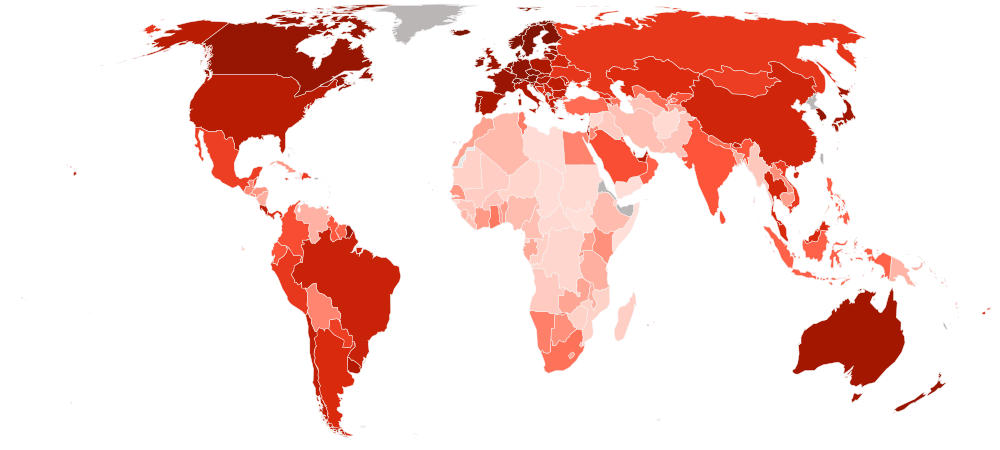
Shaded by position, deepest at the top of the ranking. It is the one map on this site drawn in the brand's red, because it is the one ordering that is ours.

The 178 countries the 2026 edition places, shaded by position — deepest at the top of the ranking, palest at the bottom. The shade is the position and nothing else: there is no score behind it.

  • Position
  • 1–25
  • 26–51
  • 52–76
  • 77–102
  • 103–127
  • 128–153
  • 154–178

Borders are de facto, from the Natural Earth outlines. The same countries grouped by region.

03Shape of the field

The spread, by continent

A middle says where a continent sits; the ticks say whether it is one tight band or two very different kinds of country sharing a name.

  • Africa

    middle 143rd of 178 · 53 placed

    Mauritius 46thSouth Sudan 177th

  • Americas

    middle 78th of 178 · 32 placed

    Canada 17thHaiti 169th

  • Asia

    middle 91st of 178 · 46 placed

    South Korea 14thYemen 176th

  • Europe

    middle 25th of 178 · 39 placed

    Switzerland 1stRussia 68th

  • Oceania

    middle 70th of 178 · 8 placed

    New Zealand 17thPapua New Guinea 138th

Each tick is one placed country, laid out from first on the left to 178th on the right; the tall mark is the continent’s middle — half its placed countries above, half below. It is a median rather than an average, and it is unweighted by population, so a continent’s mark says something about its countries and nothing about its people.

04178 placed · positions

Every country

The full 2026 ranking, best first, with each country's standing on each of the 16 subjects that voted. Every row is in the page whether or not it is on screen.

Showing 25 of 178 countries

The Nations Inquiry Country Index 2026: 178 countries in position order, best first, each with its standing on each of the 16 subjects that voted.
PositionCountryGovernanceEconomyWorkEducationHealthDevelopmentEnvironmentGenderDemocracyPeaceRiskMobilityFoodPovertyEnergyDigital
1SwitzerlandCHE6 of 19410 of 1764 of 1824 of 17110 of 2008 of 196100 of 18130 of 18312 of 19818 of 1773 of 19236 of 1477 of 17534 of 15910 of 19318 of 198
2DenmarkDNK1 of 1946 of 17621 of 18232 of 17138 of 2003 of 196160 of 18131 of 1832 of 19820 of 1774 of 19226 of 1475 of 17541 of 1596 of 19325 of 198
3IcelandISL19 of 1944 of 1761 of 182—21 of 20014 of 19682 of 18132 of 18317 of 1981 of 17710 of 19279 of 14765 of 17513 of 1595 of 19348 of 198
No standing on Education & Knowledge — Iceland holds too few of that subject’s keys, so it casts no vote in this row. Every reading for Iceland
4NorwayNOR4 of 19414 of 17631 of 18241 of 17113 of 2002 of 196120 of 18111 of 1831 of 19829 of 17713 of 19254 of 14737 of 17515 of 1592 of 19339 of 198
5SwedenSWE3 of 19417 of 17651 of 18214 of 17118 of 2005 of 196104 of 18116 of 18310 of 19821 of 17720 of 19220 of 14742 of 17546 of 1596 of 19315 of 198
6FinlandFIN5 of 1945 of 17682 of 18224 of 17122 of 20016 of 196112 of 18117 of 1835 of 19845 of 1779 of 19236 of 14734 of 17519 of 15914 of 19311 of 198
7jointAustriaAUT15 of 1941 of 17631 of 18231 of 17120 of 20015 of 196149 of 18114 of 18314 of 19843 of 17711 of 19221 of 1471 of 17549 of 1599 of 19317 of 198
7jointLuxembourgLUX16 of 19412 of 17649 of 18219 of 1717 of 20023 of 196150 of 18166 of 1834 of 1989 of 1772 of 19247 of 1474 of 17535 of 15916 of 19321 of 198
9IrelandIRL10 of 19419 of 17683 of 182—27 of 2006 of 196132 of 18121 of 1838 of 19813 of 17723 of 19239 of 1472 of 17518 of 15946 of 1934 of 198
No standing on Education & Knowledge — Ireland holds too few of that subject’s keys, so it casts no vote in this row. Every reading for Ireland
10NetherlandsNLD13 of 1948 of 1767 of 182—41 of 2009 of 196143 of 18126 of 18329 of 19846 of 17746 of 1926 of 14732 of 1757 of 15936 of 19312 of 198
No standing on Education & Knowledge — Netherlands holds too few of that subject’s keys, so it casts no vote in this row. Every reading for Netherlands
11CzechiaCZE22 of 19424 of 17624 of 182—27 of 20026 of 196163 of 18133 of 18320 of 19810 of 1776 of 19225 of 1473 of 1753 of 15973 of 19327 of 198
No standing on Education & Knowledge — Czechia holds too few of that subject’s keys, so it casts no vote in this row. Every reading for Czechia
12SloveniaSVN33 of 19411 of 17618 of 182—8 of 20013 of 196142 of 1817 of 18342 of 19839 of 17718 of 19251 of 14712 of 1752 of 15939 of 19338 of 198
No standing on Education & Knowledge — Slovenia holds too few of that subject’s keys, so it casts no vote in this row. Every reading for Slovenia
13GermanyDEU13 of 1943 of 1764 of 18220 of 17116 of 2004 of 196157 of 18118 of 18337 of 19853 of 17731 of 19211 of 1476 of 17564 of 15935 of 19323 of 198
14South KoreaKOR19 of 19415 of 1763 of 1821 of 1715 of 20024 of 196174 of 18122 of 18336 of 19863 of 17755 of 1923 of 14717 of 17538 of 15989 of 1933 of 198
15BelgiumBEL28 of 1949 of 17654 of 182—23 of 2007 of 196169 of 1816 of 18325 of 19846 of 17759 of 19216 of 14728 of 17510 of 15938 of 19318 of 198
No standing on Education & Knowledge — Belgium holds too few of that subject’s keys, so it casts no vote in this row. Every reading for Belgium
16EstoniaEST9 of 19433 of 17637 of 18261 of 17111 of 20022 of 196155 of 18119 of 1835 of 19832 of 17714 of 19248 of 14730 of 17537 of 15937 of 1937 of 198
17jointCanadaCAN8 of 19418 of 17636 of 182—33 of 20027 of 196151 of 18120 of 18320 of 19834 of 17772 of 19230 of 14731 of 17540 of 15920 of 1938 of 198
No standing on Education & Knowledge — Canada holds too few of that subject’s keys, so it casts no vote in this row. Every reading for Canada
17jointNew ZealandNZL2 of 19429 of 17623 of 18238 of 17152 of 20016 of 196122 of 1819 of 1835 of 1985 of 17737 of 19249 of 14771 of 175—12 of 19350 of 198
No standing on Poverty & Inequality — New Zealand holds too few of that subject’s keys, so it casts no vote in this row. Every reading for New Zealand
19FranceFRA21 of 1947 of 17661 of 1829 of 17135 of 20019 of 196140 of 18110 of 18340 of 19895 of 17752 of 19219 of 14719 of 17529 of 15932 of 19314 of 198
20LithuaniaLTU17 of 19421 of 17648 of 1824 of 17131 of 20029 of 196116 of 1815 of 18330 of 19842 of 17719 of 19242 of 14733 of 17584 of 15921 of 19333 of 198
21United KingdomGBR18 of 19426 of 17633 of 182—38 of 20025 of 196127 of 18144 of 18349 of 19860 of 17728 of 19213 of 14710 of 17550 of 15933 of 1935 of 198
No standing on Education & Knowledge — United Kingdom holds too few of that subject’s keys, so it casts no vote in this row. Every reading for United Kingdom
22PortugalPRT27 of 19432 of 17658 of 182—26 of 20034 of 196124 of 18126 of 18332 of 19821 of 17730 of 19231 of 14713 of 17552 of 15918 of 19341 of 198
No standing on Education & Knowledge — Portugal holds too few of that subject’s keys, so it casts no vote in this row. Every reading for Portugal
23JapanJPN10 of 1942 of 1762 of 182—6 of 20018 of 196161 of 181118 of 18315 of 19812 of 17770 of 19210 of 14747 of 17557 of 15979 of 1939 of 198
No standing on Education & Knowledge — Japan holds too few of that subject’s keys, so it casts no vote in this row. Every reading for Japan
24AustraliaAUS7 of 19427 of 1764 of 1828 of 17137 of 20011 of 196127 of 18123 of 18324 of 19851 of 17764 of 19238 of 14739 of 17566 of 15977 of 19320 of 198
25LatviaLVA29 of 19439 of 17642 of 18248 of 17129 of 20040 of 19696 of 1811 of 18327 of 19823 of 17744 of 19246 of 14745 of 17554 of 15925 of 19334 of 198

Every number in this table is a position — a place in this edition, ours and not any publisher’s. A subject cell shows where the country came on that subject alone, in a field of its own size, which is why the cells do not average to the overall position. “Joint” means another country shares the place. “—” means the country holds too few of that subject’s keys to be given a standing on it. Hovering a position shows what it rests on: how many subjects and keys placed that country, and the range it would sit in if any one key were left out, recomputed under the same floors — so a wide range is a position resting on less than it looks. Each country’s own profile prints that range in full, and this ranking’s method is published in full. Position 1st to 178th; the row addresses are #ISO codes, so /country-index/2026#PAK opens Pakistan’s row.

0516 subjects

Subject by subject

One position across 16 subjects hides the most interesting thing in the data: the countries that disagree with themselves.

All subjects

“Stands higher here” compares a country’s place on the subject with its place overall, after dividing each by its own field — the two fields are different sizes, so a difference of places would compare two different rulers. Only ranked countries can appear, because a country with no overall position has nothing to be out of step with; the country named first, by contrast, is first among everyone with a standing on that subject, placed or not.

06The honest half

Not ranked, and why

Every country this edition measured and could not place, with the number of subjects it does hold a standing on.

46 countries and territories are measured by the 2026 edition and not placed by it. The index asks for a standing on 12 of the 16 subjects before it will give a country a position, and these fall short of that. It is a gap in what the world’s statistical agencies publish, not a judgement about any country — and each one still has a profile with every reading this site does hold.

One subject short5

Measured on 11 of the 16 voting subjects — everything the index asks for but one. A single missing report is the difference between a place in the ranking and none.

Most of the way11

Standings on 6 to 10 subjects. These are countries the world's statistical agencies cover in part: enough to read them subject by subject, not enough to place them overall.

A few subjects only23

Standings on 1 to 5 subjects. Mostly small states and territories, which the large cross-country datasets sample thinly or fold into a neighbour.

No subject measured7

Not one of the 16 subjects could be read for these. They are in the registry, and the index has nothing to say about them — which is printed here rather than left to look like an oversight.

The figure beside each name is the number of subjects it holds a standing on. Those standings are real and are published — a country here can still be read subject by subject on its own profile and on each subject’s page. What it cannot have is one position built from too little.

07The inputs

What voted in this edition

Every key statistic with its publisher, its edition, the year its numbers describe, the size of its field, whether its order is the publisher's or ours, and its licence.

The raw tables

The 55 statistics that decided the 2026 ranking, by the subject each votes in. Everything else this site holds is context: charted, downloadable, and given no vote.

Where each key comes from, and on what termsPublisher, edition, the year it describes, its field, whose order it is and its licence — 55 keys from 24 publishers, 9 of them ranked by the publisher itself.
The key statistics voting in the 2026 edition, by subject, with publisher, edition, data year, field size, rank source and licence.
StatisticPublisherEditionDescribesCountriesOrder fromLicence
Governance & Institutions4 keys
Corruption Perceptions IndexHow much corruption the people who actually deal with a government perceive — an outcome, where the other keys measure the state’s capacity and the limits the law puts on it.Transparency International20252025182publisher’s rankCC BY 4.0 (the data), CC BY-ND 4.0 (the website and report)
Government EffectivenessThe quality of public services and the civil service that delivers them, and the credibility of a government's commitment to its own policies. Where the Corruption Perceptions Index asks whether a state is honest, this asks whether it is competent.World Bank Group20252025209position · derivedCC BY 4.0
Judicial Constraints on the Executive IndexWhether the executive respects the constitution and obeys the courts, and whether the courts can rule against it freely — the law binding those who write it.V-Dem Institute, University of Gothenburg20252025176position · derivedCC BY-SA 4.0
Statistical Performance IndicatorsWhether a state can measure its own country. Nothing else here tests the capacity of the statistical system itself.World Bank Group20242024188position · derivedCC BY 4.0
Economy & Innovation4 keys
Account Ownership at a Financial InstitutionWhether ordinary adults are inside the financial system at all, which output per person does not reveal.World Bank Group20242024139position · derivedCC BY 4.0
Economic Complexity IndexWhat an economy knows how to make, read from the diversity and rarity of what it exports.Growth Lab at Harvard University20242024145publisher’s rankCC0 1.0
Firms with a Bank Loan or Line of CreditWhether businesses can borrow from the formal financial system — the firm-level counterpart to adults holding a bank account.World Bank Group20252025170position · derivedCC BY 4.0
GDP per Capita (PPP)Output per person: the standard measure of an economy's size set against the population it has to support.World Bank Group20252025185position · derivedCC BY 4.0
Work & Labour4 keys
Employment-to-Population RatioHow much of the working-age population is actually in work — the half of the picture unemployment hides, because people who stop looking stop being counted.International Labour Organization (ILO)20252025182position · derivedCC BY 4.0
Labour Income ShareHow much of national income reaches workers rather than owners of capital.International Labour Organization (ILO)20252025182position · derivedCC BY 4.0
Unemployment RateThe share of people looking for work who cannot find it.International Labour Organization (ILO)20252025182position · derivedCC BY 4.0
Vulnerable EmploymentHow much work is own-account or unpaid family labour, carrying no contract and no protection.International Labour Organization (ILO)20252025182position · derivedCC BY 4.0
Education & Knowledge4 keys
Government Spending on EducationWhat a state chooses to spend on education, as a share of its economy — the input, where the other two keys measure reach.UNESCO Institute for Statistics (UIS)20232023123position · derivedCC BY-SA 4.0
Out-of-School Rate, PrimaryPrimary-age children who are not in school at all: the floor of an education system.UNESCO Institute for Statistics (UIS)20242024121position · derivedCC BY-SA 4.0
Upper Secondary Completion RateHow far a schooling system carries the young people who get through primary — the only key here that measures anything past childhood.UNESCO Institute for Statistics (UIS)20252025164position · derivedCC BY-SA 4.0
Youth Literacy RateWhether 15- to 24-year-olds can read and write — the only key here that tests what a schooling system produced, rather than how many passed through it or what it cost.UNESCO Institute for Statistics (UIS)20242024132position · derivedCC BY-SA 4.0
Health & Wellbeing4 keys
Life Expectancy at BirthHow long people actually live — the one measure of adult health on this site. Child mortality, which it correlates with, is a measure of a health system's reach in the first five years; this is the whole span.UN DESA Population Division20232023222position · derivedCC BY 3.0 IGO
Prevalence of Severe Food InsecurityThe share of people who went without food, established by asking them rather than by modelling the supply.Food and Agriculture Organization of the United Nations (FAO)20232023133position · derivedCC BY 4.0
Stunting Prevalence in Children Under FiveChildren under five who are too short for their age — the mark chronic undernutrition leaves on a body, which says what early deprivation did rather than how many died of it.UNICEF, WHO and World Bank Group (Joint Malnutrition Estimates)20242024134position · derivedCC BY 3.0 IGO
Under-Five Mortality RateDeaths before a fifth birthday, the most widely used summary of whether a health system reaches people.UN Inter-agency Group for Child Mortality Estimation (UN IGME)20242024200position · derivedCC BY 3.0 IGO
Development & Human Capital3 keys
Human Development IndexThe standard composite of health, schooling and income, carrying UNDP's own published rank.UNDP Human Development Report Office20232023193publisher’s rankCC BY 3.0 IGO
Maternal Mortality RatioWhether a woman survives giving birth — the reach of a health system at the moment it is hardest to fake.UN Maternal Mortality Estimation Inter-Agency Group (MMEIG)20232023195position · derivedCC BY 3.0 IGO
Social Protection CoverageThe share of people covered by at least one social protection benefit: whether the state catches anybody when they fall.International Labour Organization (ILO)20252025208position · derivedCC BY 4.0
Environment & Sustainability3 keys
CO₂ Emissions per CapitaHow much carbon dioxide a country's own fuel burning puts into the air for each person living there.Global Carbon Project20242024210position · derivedCC BY 4.0
Ecological FootprintHow much of the planet's biological capacity a country's own consumption uses up.Global Footprint Network20252025126position · derivedCC BY-SA 4.0
Water StressWhether a country withdraws more freshwater than nature replaces: the one pressure in this subject a country creates for itself rather than faces.Food and Agriculture Organization of the United Nations (FAO)20232023177position · derivedCC BY 4.0
Gender & Equality4 keys
Firms with a Female Top ManagerThe share of firms whose top manager is a woman: economic power held, beside the political power and the legal and social rules the other keys in this subject measure.World Bank Group20252025170position · derivedCC BY 4.0
Social Institutions and Gender IndexDiscrimination in social institutions and norms. Correlates 0.850 with Women, Business and the Law, inside the 0.92 bar, and kept because law and custom diverge widely.OECD20232023140position · derivedOECD Terms and Conditions — data clause
Women, Business and the LawThe gap written into the statute book, which a country can close while outcomes lag for a generation.World Bank Group20242024190position · derivedCC BY 4.0
Women's Political Empowerment IndexPolitical power held by women in practice — their civil liberties, their part in civil society and their share of political office — where the law and custom keys measure the rules they live under.V-Dem Institute, University of Gothenburg20252025176position · derivedCC BY-SA 4.0

Democracy & Civil Liberties3 keys
Civic Space RatingsWhether people can assemble, organise and speak in practice this year. Correlates 0.915 with V-Dem, just inside the 0.92 bar, and kept because a country can hold real elections while closing civic space between them.CIVICUS20252025198position · derivedCC BY-SA 4.0
Rule of LawWhether the law binds those who write it — contract enforcement, property rights, the police and the courts. Where the other two keys measure who holds power and what people may do, this measures whether power itself is bound by rules.World Bank Group20252025211position · derivedCC BY 4.0
V-Dem Electoral Democracy IndexRegime type as assessed by scholars: whether elections are genuine and whether rulers can be removed by them.V-Dem Institute, University of Gothenburg20252025176position · derivedCC BY-SA 4.0
Peace & Security4 keys
Global Militarisation IndexHow much of a country's resources sit with its military rather than its hospitals and schools, comparing spending, personnel and heavy weapons against health provision. Correlates 0.02 with political stability: a heavily armed country and an unstable one are genuinely different things, which is why the topic needs both.Bonn International Centre for Conflict Studies (BICC)20232023149publisher’s rankCC BY
Physical Violence IndexWhether the state kills or tortures the people it governs.V-Dem Institute, University of Gothenburg20252025176position · derivedCC BY-SA 4.0
Political Stability and Absence of ViolenceWhether a country is at risk of violent upheaval — politically motivated violence, terrorism and the threat of destabilisation. It is the closest measure this site has to whether a state is at peace with itself.World Bank Group20252025211position · derivedCC BY 4.0
Political Violence by Non-State ActorsViolence used for political ends by groups outside the state — militias, armed party wings and insurgents — the other side of the state violence that Physical Violence measures.V-Dem Institute, University of Gothenburg20252025171position · derivedCC BY-SA 4.0
Risk & Resilience3 keys
Climate Vulnerability (ND-GAIN)How exposed and sensitive a country’s food, water, health, ecosystems, housing and infrastructure are to a changing climate, set against its capacity to adapt — the slow-onset climate risk the hazard and crisis indices do not isolate.Notre Dame Global Adaptation Initiative (ND-GAIN), University of Notre Dame20242024190publisher’s rankCC BY 3.0 Unported
INFORM Risk IndexHumanitarian crisis risk, which counts conflict and displacement that the hazard indices leave out. Correlates 0.468 with the World Risk Index.European Commission Joint Research Centre, with the Inter-Agency Standing Committee20262025191position · derivedCC BY 4.0 (via the European Commission's reuse policy)
World Risk IndexExposure to natural hazards set against the capacity a country has to cope with them.Institute for International Law of Peace and Armed Conflict (IFHV), Ruhr University Bochum20252025193position · derivedCC BY 4.0
Mobility & Trade3 keys
ICT Goods ExportsHow far a country is plugged into global technology trade.UN Trade and Development (UNCTAD)20242024120position · derivedCC BY 3.0 IGO
Liner Shipping Connectivity IndexHow much of the world's container shipping actually calls at a country's ports — the infrastructure side of connectedness, where logistics performance is the paperwork side.UN Trade and Development (UNCTAD)20252025168publisher’s rankCC BY 3.0 IGO
Logistics Performance IndexHow efficiently goods actually cross a country's borders, ports and customs.World Bank Group20232023139publisher’s rankCC BY 4.0
Food & Agriculture4 keys
Agriculture Orientation IndexHow much public spending agriculture attracts set against the share of the economy it produces — whether a state invests in its farms or lives off them.Food and Agriculture Organization of the United Nations (FAO)20242024132position · derivedCC BY 4.0
Cereal YieldHow much food a hectare of land produces: the clearest single measure of how productively a country farms.Food and Agriculture Organization of the United Nations (FAO)20232023179position · derivedCC BY 4.0
Dietary Energy SupplyWhether the food a country produces and imports covers what its population needs to eat, measured before anyone has eaten it.Food and Agriculture Organization of the United Nations (FAO)20242024155position · derivedCC BY 4.0
Organic Agricultural AreaFarmland managed without synthetic fertiliser or pesticide — how a country farms, set beside how much it grows.Food and Agriculture Organization of the United Nations (FAO)20242024156position · derivedCC BY 4.0
Poverty & Inequality2 keys
Gini IndexHow evenly income or consumption is shared across a whole population — the distance between rich and poor that an average income cannot show.World Bank Group20232023159position · derivedCC BY 4.0
Poverty Gap at $3.00 a DayHow far below the $3.00-a-day extreme poverty line people fall, averaged over the whole population — how many are poor and how poor they are, in one reading.World Bank Group20232023159position · derivedCC BY 4.0
Energy3 keys
Carbon Intensity of ElectricityHow much greenhouse gas a country's power stations emit for every unit of electricity they produce.Ember20242024193position · derivedCC BY 4.0
Renewable Share of Electricity GenerationHow much of the electricity a country generates already comes from renewable sources.Ember20242024193position · derivedCC BY 4.0
World Energy Trilemma IndexHow a country's energy system balances security of supply, affordability and environmental impact — three pressures that trade off against one another.World Energy Council20232023126publisher’s rankExpress reuse grant (no Creative Commons licence named)
Digital & Technology3 keys
Digitally-Deliverable Services ExportsHow much of what a country sells abroad in services is delivered over networks — software, finance, telecoms and professional services — its place in the world’s digital trade.UN Trade and Development (UNCTAD)20242024170position · derivedCC BY 3.0 IGO
Government AI Readiness IndexWhether a government is equipped to use modern technology in what it does — its data, its skills and its rules.Oxford Insights20252025195publisher’s rankCC BY-SA 4.0
GovTech Maturity IndexHow far a state has actually got with digital government — the systems it runs and the services it delivers, where AI readiness measures what it is equipped to adopt next.World Bank Group20252025196position · derivedCC BY 4.0
The closest pair in each subjectThe correlation test every pair of keys inside a subject must pass: none may reach 0.92. The tightest the 2026 edition admitted is 0.918.

Two keys measuring one thing is that thing voting twice, so a key correlating at 0.92 or more with another in the SAME subject is refused. The judgement is made inside a subject and never globally: almost every welfare measure correlates with income, and a global cut would leave Health with two keys and Mobility with none. Here is the tightest pair the 2026 edition admitted in each subject — every one of them under the bar.

SubjectClosest pairCountriesCorrelation
Democracy & Civil LibertiesCivic Space Ratings ~ V-Dem Electoral Democracy Index1760.918
Health & WellbeingLife Expectancy at Birth ~ Under-Five Mortality Rate2000.913
Governance & InstitutionsCorruption Perceptions Index ~ Government Effectiveness1820.907
Development & Human CapitalHuman Development Index ~ Maternal Mortality Ratio1910.897
EnergyCarbon Intensity of Electricity ~ Renewable Share of Electricity Generation1930.895
Digital & TechnologyGovernment AI Readiness Index ~ GovTech Maturity Index1930.871
Environment & SustainabilityCO₂ Emissions per Capita ~ Ecological Footprint1260.867
Gender & EqualitySocial Institutions and Gender Index ~ Women, Business and the Law1400.845
Economy & InnovationEconomic Complexity Index ~ GDP per Capita (PPP)1380.811
Education & KnowledgeUpper Secondary Completion Rate ~ Youth Literacy Rate1150.800
Peace & SecurityPolitical Stability and Absence of Violence ~ Political Violence by Non-State Actors1710.785
Work & LabourEmployment-to-Population Ratio ~ Unemployment Rate1820.641
Risk & ResilienceClimate Vulnerability (ND-GAIN) ~ INFORM Risk Index1880.627
Mobility & TradeLiner Shipping Connectivity Index ~ Logistics Performance Index1120.620
Food & AgricultureCereal Yield ~ Dietary Energy Supply1510.611
Poverty & InequalityGini Index ~ Poverty Gap at $3.00 a Day1590.546

What did not vote

No key was demoted in this edition: every candidate that carried keyTopic passed all seven admission tests when they were re-run for 2026.

Money & Public Finance, People & Population cast no vote in 2026.

  • Money & Public Finance — 0 admitted keys: No indicator declares keyTopic "money". Nothing has been nominated to measure this subject, so there is nothing for the admission tests to accept or reject.
  • People & Population — 0 admitted keys: No indicator declares keyTopic "people". Nothing has been nominated to measure this subject, so there is nothing for the admission tests to accept or reject.

08The working, shown

How this edition was built

The Country Index publishes a position — a place in a list — and never a mark out of anything. The 2026 edition is worked out like this.

  1. A few key statistics vote. Everything else is context. 55 statistics are keys in this edition, spread across 16 subjects, and they are the only things that decide a position. Every other statistic on the site is still charted, linked and downloadable — it simply has no vote. That split is the whole point: when every statistic voted, importing five more labour figures quietly made the index more about labour, without anyone deciding it should be.
  2. Each key is read at one edition, matched by the year it describes. Publishers number their reports differently — a report headed 2026 may describe 2025 or the year before — so a key is chosen by the year its numbers cover, not the year on its cover. Where a publisher has nothing for 2025 we fall back at most 2 years; beyond that the key drops out rather than passing off old numbers as current. 7 of the keys are not single-year reports but a publisher’s latest-available compilation, in which every country carries its own survey year — a literacy rate measured in one country five years ago and in another last year. Those are dated row by row, and a reading more than 10 years older than the compilation is set aside rather than compared. This edition is therefore built from readings describing 2013–2025, which is the honest span rather than one tidy year.
  3. Dividing by the field first is the central idea, and the one thing that must not be skipped. A place carries the size of its list inside it: 22nd of 44 and 108th of 215 are the same showing, and averaging the numbers 22 and 108 says loudly that they are not. Fields on this site run from about 44 countries to about 215, so averaging raw places would hand a quiet bonus to any country that happens to be measured in small ones — across the site that distortion tracks average field size at 0.72, which is a thumb on the scale rather than noise. Dividing each place by its own field removes the size and leaves only the showing. So this is not a rejection of averaging ranks; it is that idea with the one correction that makes it sound.
  4. The subjects are then averaged — not the statistics. One subject, one vote, however many keys sit beneath it. That is what stops the index tilting toward whichever subject we happened to import most of. A country is ranked at all only if it holds standings on 75% of the voting subjects, rounded — 12 of 16 this edition. 178 countries clear that bar and 46 are listed unranked, each with the count that excluded it, rather than quietly dropped. An edition is only publishable at all with at least 7 voting subjects.
  5. The average itself is never published. It exists — it is what the countries are put in order by — but it is our arithmetic with nothing anchoring it, so it is in no page and no download. Every composite that does print a number explains what the number is measured against: the Human Development Index has fixed goalposts, the Environmental Performance Index has targets. This one would have none, so a 0–100 figure here would read as a measurement somebody made when it is really a mean of positions that moves with the field. What is published instead is the position and the field it is a position of, with the range below. Two countries level at 1 decimal place are printed as joint rather than split by float noise.

5 further steps — how a subject standing is built, the seven tests a key re-sits every edition, the range printed with every position, and which ranks are the publishers’ own — are set out in full on the method page, along with the register behind it.

09Caveats

How to read a standing

It is relative

A position says where a country places against the others measured alongside it, so it can move because they moved. The publishers behind these 55 statistics did not agree to be read together, and this edition’s field of 178 is not the same field as any single report’s.

It carries a range

Each row carries the span its position would move within if any single key were dropped and the ranking rebuilt under the same floors. The middle row moves by about 10 places, and the widest — Tonga — would sit anywhere from 71 to 104. Hover a position in the table to read its own range. A gap of two or three places between two countries is not a finding; a gap of forty is.

It is not a score

No 0–100 number is published here or anywhere else on this site. What orders the countries is a mean of their standings, and it has nothing to be measured against — so publishing it would dress our arithmetic up as somebody’s measurement. The order is the finding; the number behind it is working.

10Questions

Country Index 2026: questions and answers

What does the 2026 edition actually measure?

55 key statistics, grouped into 16 subjects that each cast one vote however many statistics sit beneath them. The sources describe 2013 to 2025: publishers release on their own schedules, so an edition is named for the year it is published and honestly described by the span its sources cover.

Why is the 2026 edition not about 2026?

Because no statistical agency has published 2026 yet. Each key is matched on the year its numbers describe rather than the year printed on its cover, and a source more than two years older than the edition is dropped rather than carried forward. That is what makes the span 2013–2025 rather than one tidy year.

Will this edition change?

No. Once published an edition is frozen and is never quietly refreshed — an article written about the 2026 ranking should still find the 2026 numbers years later. When the sources move on, the result is a new edition at its own address, not an edit to this one. Corrections are published separately and dated.

Did every subject vote in 2026?

No. Money & Public Finance, People & Population had too few admitted keys and cast no vote in this edition. The statistics themselves are still published in full; the index is simply silent on that subject rather than guessing at it.

How do I cite it?

Cite the edition rather than the hub, because an edition is fixed: "Nations Inquiry Country Index 2026. Nations Inquiry." with this page's address. The underlying numbers belong to their publishers, each credited and linked in the sources section.

11Credit

Citation and licence

How to cite this edition

Nations Inquiry Country Index 2026. Nations Inquiry. https://nationsinquiry.com/country-index/2026

The ranking is this site’s own construction and is published under CC BY-SA 4.0 — Some key inputs are ShareAlike, so this derived ranking carries the same licence. The underlying numbers belong to their publishers, each credited and licensed in section 07 above.

Every report behind this edition is charted in full on Statistics, the raw tables are at Datasets, and the method and every other edition are at the Country Index.

Feedback

Feedback

How are we doing?

Two answers are required — a rating and your email. The rest is up to you.