Loading…
The site’s own ranking
Nations Inquiry Country Index
Which countries come where, and on what?
Switzerland is placed first of the 178 countries ranked in the Nations Inquiry Country Index 2026, built from 55 key statistics across 16 subjects, each subject casting one vote, using editions describing 2013–2025. Denmark and Iceland follow. A further 46 countries are measured but not ranked: a country needs a standing on 12 of the 16 subjects before the index will place it.
Country Index 2026 · readings 2013–2025
One position per country — never a score
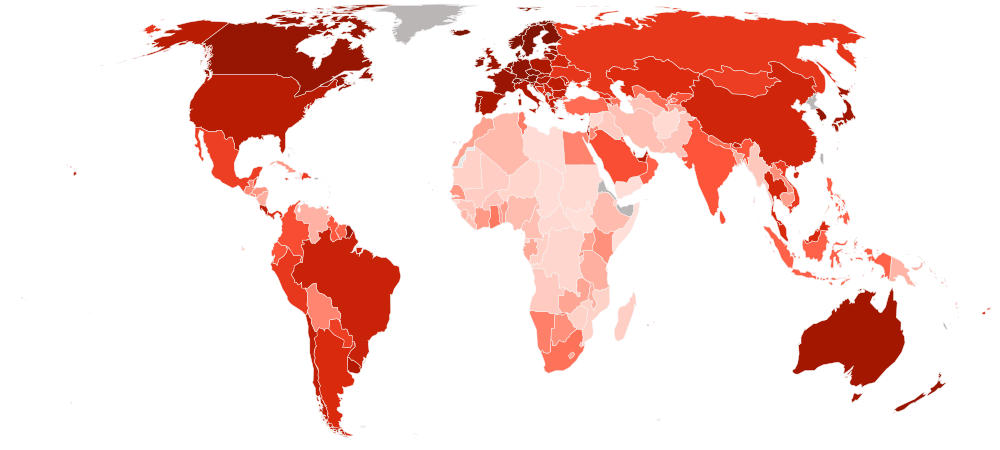
Switzerland, placed first of 178. Deepest shade at the top of the ranking, palest at the bottom; grey is a country the index measured but could not place.
01Country Index 2026 · positions
The top ten
The head of the ranking, of 178 countries placed. Each card gives a position and the field it is a position of — there is no score behind it.
 1
1Photo: Simon Koopmann derivative work: Jjtkk · CC BY-SA 2.0 de, greyscale
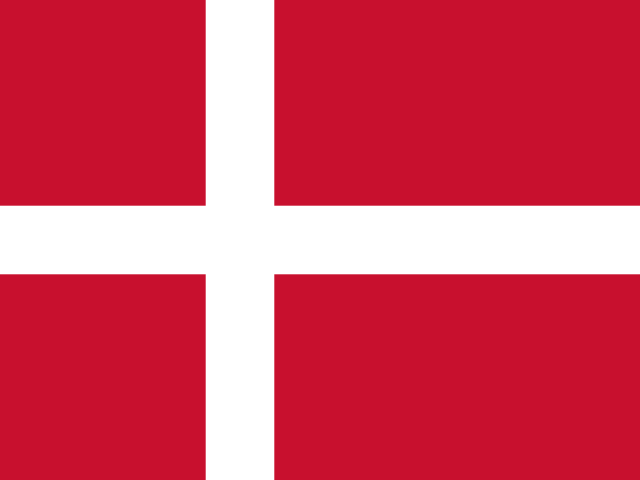
 2
2Photo: User:Aconcagua · CC BY-SA 3.0, greyscale
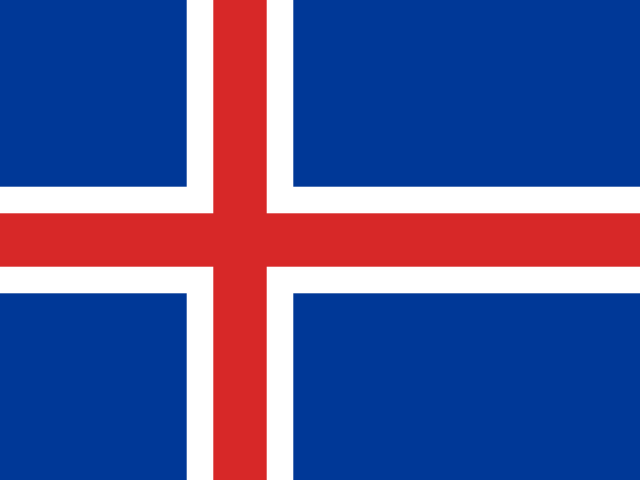
 3
3Photo: Hansueli Krapf · CC BY-SA 3.0, greyscale

- 4
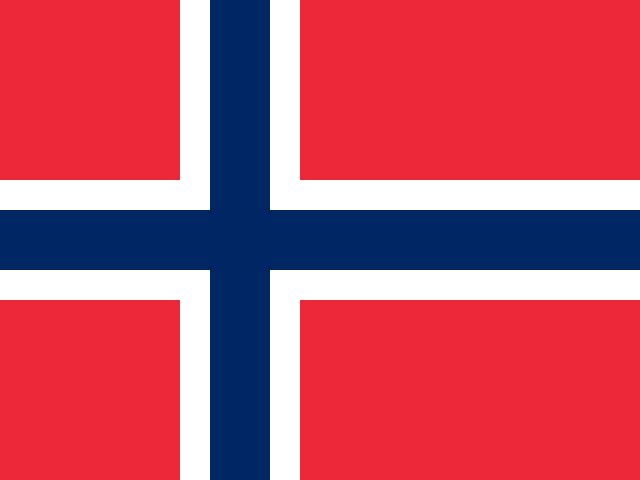 Norway16/16 subjects
 - 5
 Sweden16/16 subjects
 - 6
 Finland16/16 subjects
 - 7
 Austriajoint16/16 subjects
 - 7
 Luxembourgjoint16/16 subjects
 - 9
 Ireland15/16 subjects
 - 10
 Netherlands15/16 subjects
02Reading it honestly
What a position is, and what it is not
A ranking of countries is read as a verdict whether or not it is offered as one. This is the claim the index actually makes.
What a position is
A place in a list of 178 countries, and nothing more than that. It is worked out from 55 statistics that other bodies published — the World Bank, the UN’s agencies, Transparency International, V-Dem and others — sorted into 16 subjects that each cast one vote, however many statistics sit beneath them.
The ordering is this site’s own work. Every number underneath it belongs to its publisher, and each is named, dated and licensed on the 2026 edition page.
What it is not
- Not a score. No number out of 100 is published anywhere on this site. An unanchored score reads like a measurement; this is an order, and only the order is published.
- Not a verdict on living there. The statistics describe a country. They say nothing about what a life in it is like, and nothing here weighs what a person might actually want from one.
- Not fixed to a country. A position is relative to the field, so a country can move because other countries moved.
How firm a position is
±10
places — how far the middle row would move if any single key statistic were dropped and the ranking rebuilt under the same rules. 53% of rows move by 10 places or fewer.
The widest is Tonga, which would sit anywhere from 71 to 104 — 33 places, and a fair warning about how much that row rests on.
So: a gap of two or three places between two countries is not a finding. A gap of forty is.
0316 subjects · 55 keys
What decides a position
Each subject casts exactly one vote, however many key statistics sit beneath it — so a subject with five keys does not outweigh one with three.
01
4 key statistics
Governance & Institutions
4 keys · a country needs 2 of them for a standing
- Corruption Perceptions IndexTransparency International
- Government EffectivenessWorld Bank Group
- Judicial Constraints on the Executive IndexV-Dem Institute, University of Gothenburg
- Statistical Performance IndicatorsWorld Bank Group
194 countries hold a standing on this subject in 2026.
02
4 key statistics
Economy & Innovation
4 keys · a country needs 2 of them for a standing
- Account Ownership at a Financial InstitutionWorld Bank Group
- Economic Complexity IndexGrowth Lab at Harvard University
- Firms with a Bank Loan or Line of CreditWorld Bank Group
- GDP per Capita (PPP)World Bank Group
176 countries hold a standing on this subject in 2026.
03
4 key statistics
Work & Labour
4 keys · a country needs 2 of them for a standing
- Employment-to-Population RatioInternational Labour Organization (ILO)
- Labour Income ShareInternational Labour Organization (ILO)
- Unemployment RateInternational Labour Organization (ILO)
- Vulnerable EmploymentInternational Labour Organization (ILO)
182 countries hold a standing on this subject in 2026.
04
4 key statistics
Education & Knowledge
4 keys · a country needs 2 of them for a standing
- Government Spending on EducationUNESCO Institute for Statistics (UIS)
- Out-of-School Rate, PrimaryUNESCO Institute for Statistics (UIS)
- Upper Secondary Completion RateUNESCO Institute for Statistics (UIS)
- Youth Literacy RateUNESCO Institute for Statistics (UIS)
171 countries hold a standing on this subject in 2026.
05
4 key statistics
Health & Wellbeing
4 keys · a country needs 2 of them for a standing
- Life Expectancy at BirthUN DESA Population Division
- Prevalence of Severe Food InsecurityFood and Agriculture Organization of the United Nations (FAO)
- Stunting Prevalence in Children Under FiveUNICEF, WHO and World Bank Group (Joint Malnutrition Estimates)
- Under-Five Mortality RateUN Inter-agency Group for Child Mortality Estimation (UN IGME)
200 countries hold a standing on this subject in 2026.
06
3 key statistics
Development & Human Capital
3 keys · a country needs 2 of them for a standing
- Human Development IndexUNDP Human Development Report Office
- Maternal Mortality RatioUN Maternal Mortality Estimation Inter-Agency Group (MMEIG)
- Social Protection CoverageInternational Labour Organization (ILO)
196 countries hold a standing on this subject in 2026.
07
3 key statistics
Environment & Sustainability
3 keys · a country needs 2 of them for a standing
- CO₂ Emissions per CapitaGlobal Carbon Project
- Ecological FootprintGlobal Footprint Network
- Water StressFood and Agriculture Organization of the United Nations (FAO)
181 countries hold a standing on this subject in 2026.
08
4 key statistics
Gender & Equality
4 keys · a country needs 2 of them for a standing
- Firms with a Female Top ManagerWorld Bank Group
- Social Institutions and Gender IndexOECD
- Women, Business and the LawWorld Bank Group
- Women's Political Empowerment IndexV-Dem Institute, University of Gothenburg
183 countries hold a standing on this subject in 2026.
09
3 key statistics
Democracy & Civil Liberties
3 keys · a country needs 2 of them for a standing
- Civic Space RatingsCIVICUS
- Rule of LawWorld Bank Group
- V-Dem Electoral Democracy IndexV-Dem Institute, University of Gothenburg
198 countries hold a standing on this subject in 2026.
10
4 key statistics
Peace & Security
4 keys · a country needs 2 of them for a standing
- Global Militarisation IndexBonn International Centre for Conflict Studies (BICC)
- Physical Violence IndexV-Dem Institute, University of Gothenburg
- Political Stability and Absence of ViolenceWorld Bank Group
- Political Violence by Non-State ActorsV-Dem Institute, University of Gothenburg
177 countries hold a standing on this subject in 2026.
11
3 key statistics
Risk & Resilience
3 keys · a country needs 2 of them for a standing
- Climate Vulnerability (ND-GAIN)Notre Dame Global Adaptation Initiative (ND-GAIN), University of Notre Dame
- INFORM Risk IndexEuropean Commission Joint Research Centre, with the Inter-Agency Standing Committee
- World Risk IndexInstitute for International Law of Peace and Armed Conflict (IFHV), Ruhr University Bochum
192 countries hold a standing on this subject in 2026.
12
3 key statistics
Mobility & Trade
3 keys · a country needs 2 of them for a standing
- ICT Goods ExportsUN Trade and Development (UNCTAD)
- Liner Shipping Connectivity IndexUN Trade and Development (UNCTAD)
- Logistics Performance IndexWorld Bank Group
147 countries hold a standing on this subject in 2026.
13
4 key statistics
Food & Agriculture
4 keys · a country needs 2 of them for a standing
- Agriculture Orientation IndexFood and Agriculture Organization of the United Nations (FAO)
- Cereal YieldFood and Agriculture Organization of the United Nations (FAO)
- Dietary Energy SupplyFood and Agriculture Organization of the United Nations (FAO)
- Organic Agricultural AreaFood and Agriculture Organization of the United Nations (FAO)
175 countries hold a standing on this subject in 2026.
14
2 key statistics
Poverty & Inequality
2 keys · a country needs 2 of them for a standing
- Gini IndexWorld Bank Group
- Poverty Gap at $3.00 a DayWorld Bank Group
159 countries hold a standing on this subject in 2026.
15
3 key statistics
Energy
3 keys · a country needs 2 of them for a standing
- Carbon Intensity of ElectricityEmber
- Renewable Share of Electricity GenerationEmber
- World Energy Trilemma IndexWorld Energy Council
193 countries hold a standing on this subject in 2026.
16
3 key statistics
Digital & Technology
3 keys · a country needs 2 of them for a standing
- Digitally-Deliverable Services ExportsUN Trade and Development (UNCTAD)
- Government AI Readiness IndexOxford Insights
- GovTech Maturity IndexWorld Bank Group
198 countries hold a standing on this subject in 2026.
Money & Public Finance, People & Population cast no vote in the 2026 edition. They have fewer than the 2 admitted keys a subject needs, so the index is silent on them rather than guessing. The statistics themselves are published in full.
A country needs a standing on 12 of the 16 subjects before the index places it at all. Every other statistic this site holds is context — charted, linked and downloadable, and deliberately given no vote, so importing five more labour statistics cannot quietly make the index more about labour.
04Geography
The world by region
Each region's middle standing — half its placed countries above, half below — with the spread from its best- to its lowest-placed member.
- Africa
143rd
the middle of its 53 placed countries, of 178 ranked · 55 members in all
5th of 5 continents by that middle
Mauritius 46th · Somalia 177th
- Americas
78th
the middle of its 32 placed countries, of 178 ranked · 48 members in all
3rd of 5 continents by that middle
Canada 17th · Haiti 169th
2 members reach the top fifth of the ranking.
- Asia
91st
the middle of its 46 placed countries, of 178 ranked · 52 members in all
4th of 5 continents by that middle
South Korea 14th · Yemen 176th
5 members reach the top fifth of the ranking.
- Europe
25th
the middle of its 39 placed countries, of 178 ranked · 49 members in all
1st of 5 continents by that middle
Switzerland 1st · Russia 68th
27 members reach the top fifth of the ranking.
- Oceania
70th
the middle of its 8 placed countries, of 178 ranked · 21 members in all
2nd of 5 continents by that middle
New Zealand 17th · Papua New Guinea 138th
2 members reach the top fifth of the ranking.
The 22 sub-regions, highest middle first
- Northern Europe
6th
the middle of its 10 placed countries, of 178 ranked · 13 members in all
1st of 21 sub-regions by that middle
Denmark 2nd · Latvia 25th
10 members reach the top fifth of the ranking.
- Western Europe
10th
the middle of its 7 placed countries, of 178 ranked · 9 members in all
2nd of 21 sub-regions by that middle
Switzerland 1st · France 19th
7 members reach the top fifth of the ranking.
- Northern America
17th
the middle of its 2 placed countries, of 178 ranked · 4 members in all
3rd of 21 sub-regions by that middle
Canada 17th · United States 37th
1 member reaches the top fifth of the ranking.
- Australia and New Zealand
17th
the middle of its 2 placed countries, of 178 ranked · 2 members in all
3rd of 21 sub-regions by that middle
New Zealand 17th · Australia 24th
2 members reach the top fifth of the ranking.
- Eastern Asia
23rd
the middle of its 4 placed countries, of 178 ranked · 8 members in all
5th of 21 sub-regions by that middle
South Korea 14th · Mongolia 73rd
2 members reach the top fifth of the ranking.
- Southern Europe
32nd
the middle of its 12 placed countries, of 178 ranked · 17 members in all
6th of 21 sub-regions by that middle
Slovenia 12th · Bosnia and Herzegovina 63rd
6 members reach the top fifth of the ranking.
- Eastern Europe
39th
the middle of its 10 placed countries, of 178 ranked · 10 members in all
7th of 21 sub-regions by that middle
Czechia 11th · Russia 68th
4 members reach the top fifth of the ranking.
- Polynesia
70th
the middle of its 2 placed countries, of 178 ranked · 7 members in all
8th of 21 sub-regions by that middle
Samoa 70th · Tonga 85th
- South America
74th
the middle of its 12 placed countries, of 178 ranked · 12 members in all
9th of 21 sub-regions by that middle
Uruguay 34th · Venezuela 137th
1 member reaches the top fifth of the ranking.
- Caribbean
78th
the middle of its 10 placed countries, of 178 ranked · 24 members in all
10th of 21 sub-regions by that middle
Barbados 63rd · Haiti 169th
- Central America
81st
the middle of its 8 placed countries, of 178 ranked · 8 members in all
11th of 21 sub-regions by that middle
Costa Rica 40th · Nicaragua 134th
- Western Asia
93rd
the middle of its 17 placed countries, of 178 ranked · 19 members in all
12th of 21 sub-regions by that middle
Cyprus 35th · Yemen 176th
2 members reach the top fifth of the ranking.
- South-eastern Asia
95th
the middle of its 11 placed countries, of 178 ranked · 11 members in all
13th of 21 sub-regions by that middle
Singapore 26th · Myanmar 153rd
1 member reaches the top fifth of the ranking.
- Central Asia
100th
the middle of its 5 placed countries, of 178 ranked · 5 members in all
14th of 21 sub-regions by that middle
Kazakhstan 60th · Turkmenistan 148th
- Southern Asia
100th
the middle of its 9 placed countries, of 178 ranked · 9 members in all
14th of 21 sub-regions by that middle
Bhutan 44th · Afghanistan 172nd
- Melanesia
106th
the middle of its 4 placed countries, of 178 ranked · 5 members in all
16th of 21 sub-regions by that middle
Fiji 62nd · Papua New Guinea 138th
- Southern Africa
116th
the middle of its 5 placed countries, of 178 ranked · 5 members in all
17th of 21 sub-regions by that middle
South Africa 102nd · Eswatini 140th
- Northern Africa
127th
the middle of its 6 placed countries, of 178 ranked · 6 members in all
18th of 21 sub-regions by that middle
Tunisia 107th · Libya 174th
- Eastern Africa
143rd
the middle of its 17 placed countries, of 178 ranked · 19 members in all
19th of 21 sub-regions by that middle
Mauritius 46th · Somalia 177th
- Western Africa
144th
the middle of its 16 placed countries, of 178 ranked · 16 members in all
20th of 21 sub-regions by that middle
Cabo Verde 74th · Guinea-Bissau 168th
- Middle Africa
161st
the middle of its 9 placed countries, of 178 ranked · 9 members in all
21st of 21 sub-regions by that middle
São Tomé and Príncipe 104th · Chad 175th
- Micronesia
0 of 7 placed — too few for a middle to mean anything.
Regions are the UN Statistics Division’s M49 geoscheme, not this site’s invention, so a reader who disagrees with where a country sits is disagreeing with the UN. Each figure is a median of its placed members’ positions, unweighted by population — weighting would be an editorial opinion dressed up as a measurement, which is the same reason the index weights no subject. Every region has its own page.
05The honest half
Who is not ranked
46 countries and territories are measured by this edition and not placed by it. An absence a reader is not told about reads as coverage.
46 countries and territories are measured by the 2026 edition and not placed by it. The index asks for a standing on 12 of the 16 subjects before it will give a country a position, and these fall short of that. It is a gap in what the world’s statistical agencies publish, not a judgement about any country — and each one still has a profile with every reading this site does hold.
One subject short5
Measured on 11 of the 16 voting subjects — everything the index asks for but one. A single missing report is the difference between a place in the ranking and none.


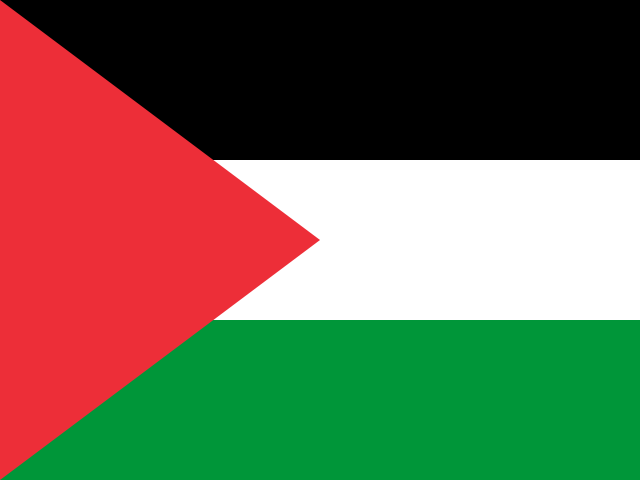
Most of the way11
Standings on 6 to 10 subjects. These are countries the world's statistical agencies cover in part: enough to read them subject by subject, not enough to place them overall.
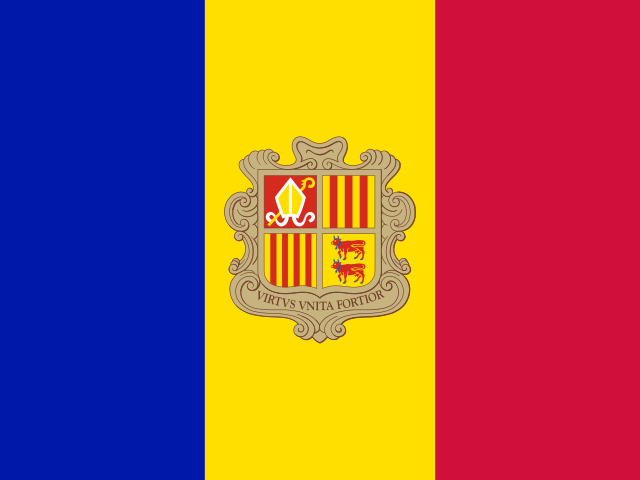 Andorra8/16
 Dominica8/16
 Kosovo9/16
 Marshall Islands8/16
 Micronesia7/16
 Nauru8/16
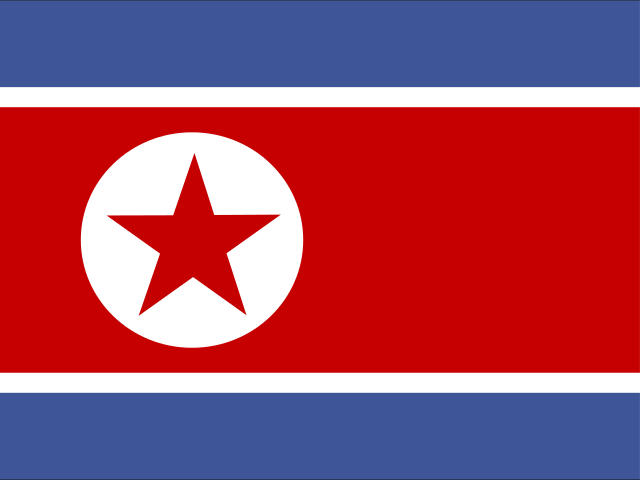 North Korea9/16
 Palau7/16
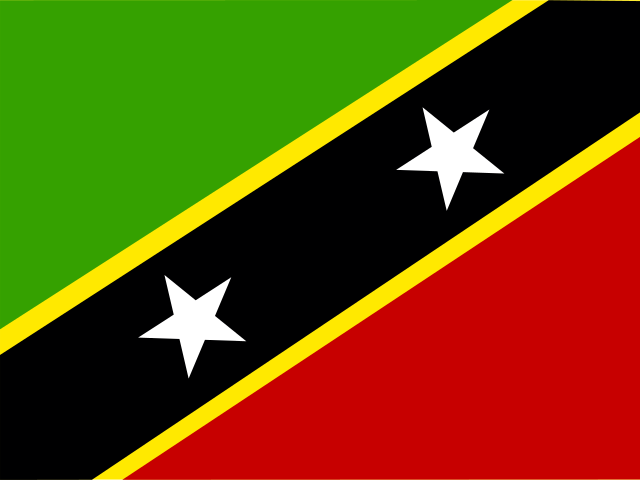 Saint Kitts and Nevis8/16
 Taiwan9/16
 Tuvalu7/16
A few subjects only23
Standings on 1 to 5 subjects. Mostly small states and territories, which the large cross-country datasets sample thinly or fold into a neighbour.
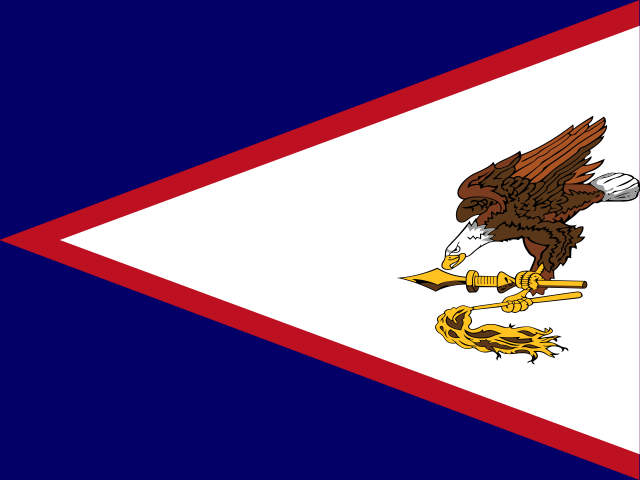 American Samoa1/16
 Anguilla1/16
 Aruba1/16
 Bermuda1/16
 British Virgin Islands2/16
 Cayman Islands3/16
- Channel Islands1/16
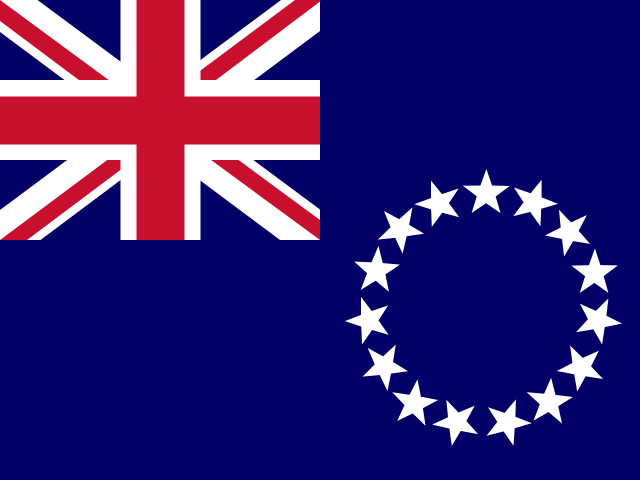 Cook Islands4/16
 Curaçao1/16
 French Polynesia3/16
 Greenland1/16
 Guam2/16
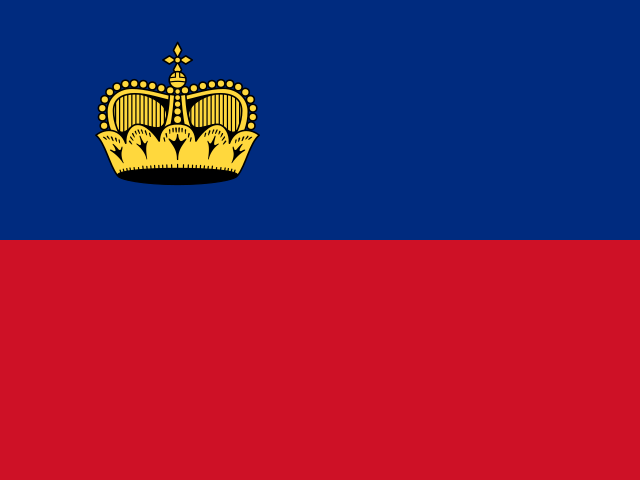 Liechtenstein4/16
 Macau4/16
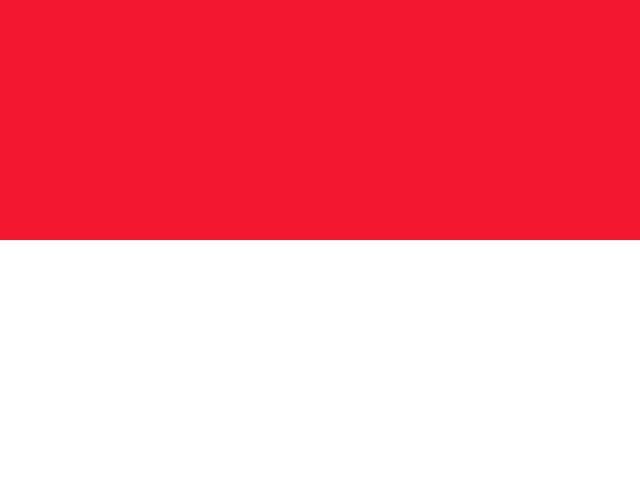 Monaco5/16
 Montserrat2/16
 New Caledonia2/16
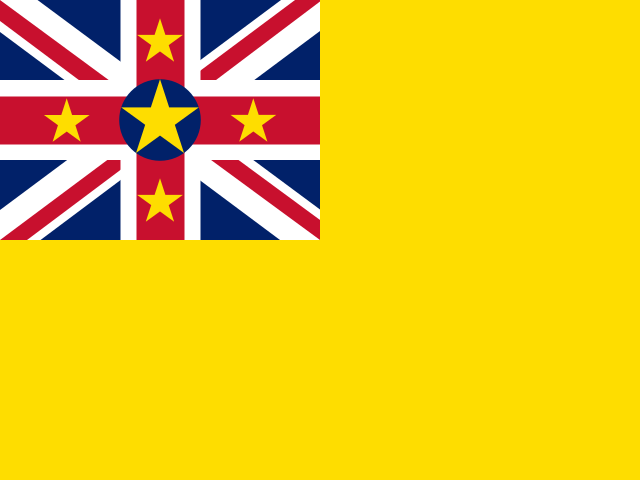 Niue1/16
 Puerto Rico4/16
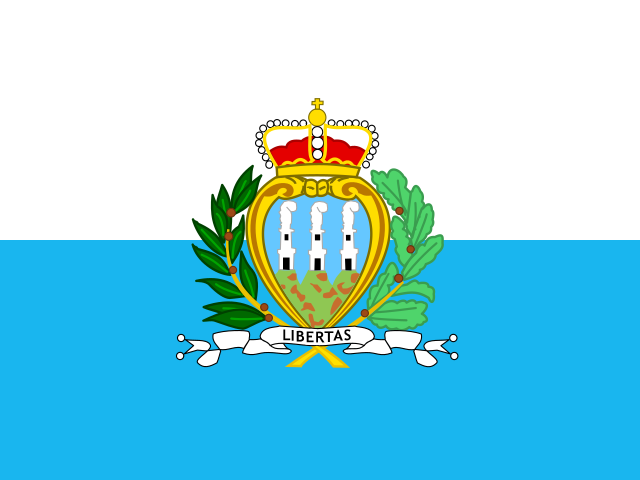 San Marino5/16
- Somaliland1/16
 Turks and Caicos Islands3/16
 United States Virgin Islands1/16
No subject measured7
Not one of the 16 subjects could be read for these. They are in the registry, and the index has nothing to say about them — which is printed here rather than left to look like an oversight.
 Faroe Islands0/16
 Gibraltar0/16
 Isle of Man0/16
 Northern Mariana Islands0/16
 Saint Martin0/16
 Sint Maarten0/16
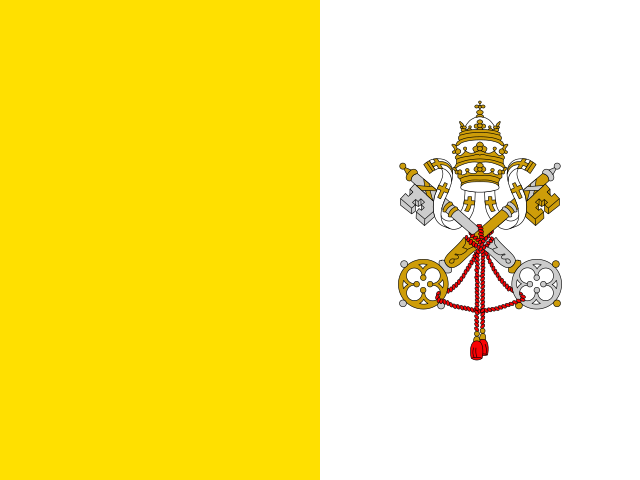 Vatican City0/16
The figure beside each name is the number of subjects it holds a standing on. Those standings are real and are published — a country here can still be read subject by subject on its own profile and on each subject’s page. What it cannot have is one position built from too little.
06The working, shown
How the Country Index is built
Every threshold below is read from the same module the build script runs, so this description cannot drift from the arithmetic it describes.
The Country Index publishes a position — a place in a list — and never a mark out of anything. The 2026 edition is worked out like this.
- A few key statistics vote. Everything else is context. 55 statistics are keys in this edition, spread across 16 subjects, and they are the only things that decide a position. Every other statistic on the site is still charted, linked and downloadable — it simply has no vote. That split is the whole point: when every statistic voted, importing five more labour figures quietly made the index more about labour, without anyone deciding it should be.
- Each key is read at one edition, matched by the year it describes. Publishers number their reports differently — a report headed 2026 may describe 2025 or the year before — so a key is chosen by the year its numbers cover, not the year on its cover. Where a publisher has nothing for 2025 we fall back at most 2 years; beyond that the key drops out rather than passing off old numbers as current. 7 of the keys are not single-year reports but a publisher’s latest-available compilation, in which every country carries its own survey year — a literacy rate measured in one country five years ago and in another last year. Those are dated row by row, and a reading more than 10 years older than the compilation is set aside rather than compared. This edition is therefore built from readings describing 2013–2025, which is the honest span rather than one tidy year.
- Every country’s published value becomes a place within that one key’s own field, and that place is then expressed as a share of the field — how far down this key’s list the country sits, rather than how many countries are above it. Keys where a higher published number is worse (child mortality, disaster risk, gender inequality) are turned round first, so the good end is always the same end. Countries with identical published values share the middle of the places they span, which keeps a key with many ties from dragging anybody up or down.
- Dividing by the field first is the central idea, and the one thing that must not be skipped. A place carries the size of its list inside it: 22nd of 44 and 108th of 215 are the same showing, and averaging the numbers 22 and 108 says loudly that they are not. Fields on this site run from about 44 countries to about 215, so averaging raw places would hand a quiet bonus to any country that happens to be measured in small ones — across the site that distortion tracks average field size at 0.72, which is a thumb on the scale rather than noise. Dividing each place by its own field removes the size and leaves only the showing. So this is not a rejection of averaging ranks; it is that idea with the one correction that makes it sound.
- A subject standing is the plain average of its keys — no weighting, because any weighting would be this site’s opinion dressed up as a measurement. A country must hold 2 of a subject’s keys — half, rounded up, and never fewer than 2 — before it is given a standing on it. A standing built from one reading, printed beside one built from four, is two different things sharing a column heading.
- The subjects are then averaged — not the statistics. One subject, one vote, however many keys sit beneath it. That is what stops the index tilting toward whichever subject we happened to import most of. A country is ranked at all only if it holds standings on 75% of the voting subjects, rounded — 12 of 16 this edition. 178 countries clear that bar and 46 are listed unranked, each with the count that excluded it, rather than quietly dropped. An edition is only publishable at all with at least 7 voting subjects.
- A key has to earn its vote in every edition. Carrying a subject in the registry is an opt-in, not an admission: seven tests are re-run each year, and a key that fails one is demoted to context for that edition with the reason published on the edition page.
- It has a better end. A share of GDP is neither good nor bad when it is high, so it cannot say who is doing well.
- It is a rate, share, index or per-person figure. A raw count ranks countries by size, a growth rate ranks them by where they started, and a base-year index only compares a country with its own past.
- It measures at least 120 countries. Expressing a place as a share of its field removes the field’s size but not its composition — a test sat by 79 mostly rich economies is measuring who was surveyed, not the world.
- It describes a year inside the window above. Older than that is stale, not current.
- No more than 10% of its field ties at either end. When 122 of 215 countries report the same value, the places derived from it read “1, 1, 1 … 123”, which is noise rather than information.
- It does not repeat another key in the same subject. A rank correlation above 0.92 counts as repeating, as does being a component or an adjusted variant of another key — two keys measuring one thing is that thing voting twice. Judged inside a subject and never across the whole index: almost every welfare measure on earth correlates with income, so a global cut would empty half the subjects.
- Its licence permits derivative works. This ranking reshapes the publisher’s numbers, and a licence forbidding derivatives forbids exactly that.
- The average itself is never published. It exists — it is what the countries are put in order by — but it is our arithmetic with nothing anchoring it, so it is in no page and no download. Every composite that does print a number explains what the number is measured against: the Human Development Index has fixed goalposts, the Environmental Performance Index has targets. This one would have none, so a 0–100 figure here would read as a measurement somebody made when it is really a mean of positions that moves with the field. What is published instead is the position and the field it is a position of, with the range below. Two countries level at 1 decimal place are printed as joint rather than split by float noise.
- Every position carries the range it would move within if any one key were left out, recomputed under the same coverage floors. A bare position claims a precision a 55-key index does not have; “132nd, range 99–133” is the honest version of the same fact, and it tells a reader which claim is solid (this country is in the bottom third) and which is not (it is precisely 132nd). A wide range is a position resting on less than it looks.
- The numbers are the publishers’; the ordering is ours. 9 of the 55 keys carry a rank their own publisher printed, and those are shown as ranks with the publisher named. For the rest this site orders the published value itself, and says position · derived wherever it does. The publishers listed on these pages did not agree to be read together, and a position here is relative: it says where a country places against the others measured alongside it, so it can move because they moved. Every key is published with its publisher, its licence and the one concept it was admitted for on each edition page, and the statistics that do not vote are charted alongside them under Topics.
07The archive
The first edition
One edition a year, each frozen once published — so a citation keeps pointing at the numbers it was written about.
08Questions
The Country Index: questions and answers
Is this a ranking of the best countries to live in?
No. It is a ranking of what 55 published statistics say, across 16 subjects — health, schooling, work, governance, environment and the rest. Those statistics describe a country; they do not describe a life in it, and nothing here weighs what a person might actually want. A country placed well can be a difficult place to live, and the index would not know.
Why is there no score out of 100?
Because there is nothing for a score to be measured against. A credible composite that prints a score says what the score is out of: the Human Development Index has fixed goalposts, the Environmental Performance Index has targets. This one had none — it was a mean of positions within whatever countries happened to be measured, so the number moved when other countries moved. Publishing the order and not the number is the honest version of what the arithmetic can support.
Why is my country not in the ranking?
The index places a country only when it holds a standing on 12 of the 16 voting subjects. 46 countries are measured but fall short of that in the 2026 edition, and each one is listed with the number of subjects it does hold. That is a gap in what the world's statistical agencies publish, not a judgement.
How firm is a country's position?
Each row carries the span its position would move within if any single key statistic were dropped. The middle row moves by about 10 places, and 53% of rows move by ten or fewer. A gap of two or three places between two countries is not a finding; a gap of forty is.
Who publishes the numbers behind it?
Other people do — the World Bank, the UN's agencies, Transparency International, V-Dem and others. Every key statistic is named on the edition page with its publisher, its edition, the year its numbers describe and its licence. The only thing this site produces is the ordering, which is published under CC BY-SA 4.0.
Can I compare this with an earlier edition?
Yes. Every edition is built by the same rules and is frozen once published, so a country's movement between them is real. Read it with the field in mind, though: a position is relative, so a country can move because other countries moved, or because a key statistic covered more countries this year than last.
09Credit
Sources, licence and citation
The 55 key statistics come from 24 publishers. The ordering is this site's; the numbers are theirs.
World Bank Group13
Account Ownership at a Financial Institution · Firms with a Bank Loan or Line of Credit · Firms with a Female Top Manager · GDP per Capita (PPP) · Gini Index · Government Effectiveness · GovTech Maturity Index · Logistics Performance Index · Political Stability and Absence of Violence · Poverty Gap at $3.00 a Day · Rule of Law · Statistical Performance Indicators · Women, Business and the Law
Food and Agriculture Organization of the United Nations (FAO)6
Agriculture Orientation Index · Cereal Yield · Dietary Energy Supply · Organic Agricultural Area · Prevalence of Severe Food Insecurity · Water Stress
International Labour Organization (ILO)5
Employment-to-Population Ratio · Labour Income Share · Social Protection Coverage · Unemployment Rate · Vulnerable Employment
V-Dem Institute, University of Gothenburg5
Judicial Constraints on the Executive Index · Physical Violence Index · Political Violence by Non-State Actors · V-Dem Electoral Democracy Index · Women's Political Empowerment Index
UNESCO Institute for Statistics (UIS)4
Government Spending on Education · Out-of-School Rate, Primary · Upper Secondary Completion Rate · Youth Literacy Rate
UN Trade and Development (UNCTAD)3
Digitally-Deliverable Services Exports · ICT Goods Exports · Liner Shipping Connectivity Index
Ember2
Carbon Intensity of Electricity · Renewable Share of Electricity Generation
Bonn International Centre for Conflict Studies (BICC)1
Global Militarisation Index
CIVICUS1
Civic Space Ratings
European Commission Joint Research Centre, with the Inter-Agency Standing Committee1
INFORM Risk Index
Global Carbon Project1
CO₂ Emissions per Capita
Global Footprint Network1
Ecological Footprint
Growth Lab at Harvard University1
Economic Complexity Index
Institute for International Law of Peace and Armed Conflict (IFHV), Ruhr University Bochum1
World Risk Index
Notre Dame Global Adaptation Initiative (ND-GAIN), University of Notre Dame1
Climate Vulnerability (ND-GAIN)
OECD1
Social Institutions and Gender Index
Oxford Insights1
Government AI Readiness Index
Transparency International1
Corruption Perceptions Index
UN DESA Population Division1
Life Expectancy at Birth
UN Inter-agency Group for Child Mortality Estimation (UN IGME)1
Under-Five Mortality Rate
UN Maternal Mortality Estimation Inter-Agency Group (MMEIG)1
Maternal Mortality Ratio
UNDP Human Development Report Office1
Human Development Index
UNICEF, WHO and World Bank Group (Joint Malnutrition Estimates)1
Stunting Prevalence in Children Under Five
World Energy Council1
World Energy Trilemma Index
The underlying reports are charted edition by edition on Statistics, every raw table is at Datasets, and each nation’s own page is in Countries A–Z.