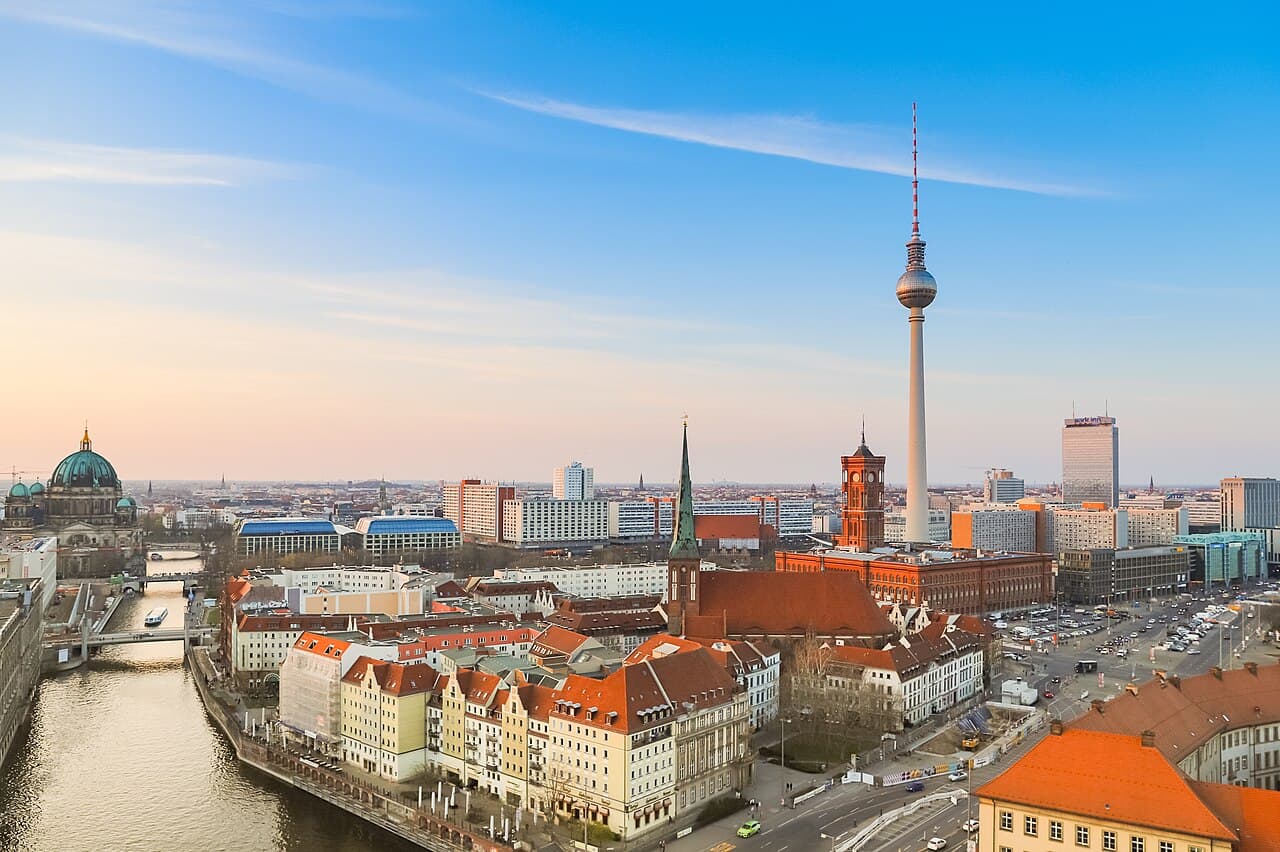
Photo: dronepicr · CC BY 2.0 · via Wikimedia Commons, shown in greyscale
Topic 06 of 18 · Country Index 2026
Germany: Development & Human Capital
Is a country turning its resources into better lives?
Germany is placed 4th of 196 countries on development & human capital in the Country Index 2026, from 3 of its 3 key statistics. Readings behind it: Social Protection Coverage 100 (2025); Maternal Mortality Ratio 3.62 (2023).
Development & Human Capital
4th
of 196 countries placed
Placed from 3 of 3 key statistics
01The evidence
The 3 key statistics that decide it
Only these place Germany on development & human capital — one vote each. Every value is the publisher’s own, read at the edition the Country Index 2026 used — or, for a survey-based key, each country’s latest reading; the grey ticks are every other country it was compared with, lowest on the left.
Key 2 of 3
Maternal Mortality Ratio
UN Maternal Mortality Estimation Inter-Agency Group (MMEIG)
Why it is a key: Whether a woman survives giving birth — the reach of a health system at the moment it is hardest to fake.
2023 edition · data for 2023 · CC BY 3.0 IGO
3.62
Maternal deaths per 100,000 live births
Lower is better
Germany: 3.62. Across the 195 countries in this edition, values run from 0.11 (Cook Islands) to 992.83 (Nigeria); the world median is 46.65.
- World median
- 46.65
- Best in Western Europe
- 3.62 Germany
- Land neighbours
- Austria 6.1 · Belgium 3.84 · Switzerland 5.46 · Czechia 2.7 · Denmark 3.67 · France 7.3 · Luxembourg 11.69 · Netherlands 4.3 · Poland 1.57
Each grey tick is one of 195 countries in the 2023 edition.
Key 3 of 3
Human Development Index
UNDP Human Development Report Office
Why it is a key: The standard composite of health, schooling and income, carrying UNDP's own published rank.
2023 edition · data for 2023 · CC BY 3.0 IGO
0.959
HDI score (0–1)
Higher is better
Ranked 5th of 193 by UNDP Human Development Report Office
Germany: 0.959. Across the 193 countries in this edition, values run from 0.388 (South Sudan) to 0.972 (Iceland); the world median is 0.762.
- World median
- 0.762
- Best in Western Europe
- 0.97 Switzerland
- Land neighbours
- Austria 0.93 · Belgium 0.951 · Switzerland 0.97 · Czechia 0.915 · Denmark 0.962 · France 0.92 · Luxembourg 0.922 · Netherlands 0.955 · Poland 0.906
Each grey tick is one of 193 countries in the 2023 edition.
02Over time
Which way Germany is moving
Each key’s published value, edition by edition, beside the world median. The Country Index 2026 is the first edition of the standing, so the standing itself has no history to chart yet.
Maternal Mortality Ratio
Maternal deaths per 100,000 live births · lower is better
GermanyWorld median
Germany fell from 6.73 in 2000 to 3.62 in 2023; the world median went from 70.99 to 46.65.
Every year’s figures
Year Germany World median 2023 3.62 46.7 2022 4.03 53.0 2021 4.46 76.6 2020 4.23 56.0 2019 3.97 48.4 2018 4.21 49.3 2017 4.21 47.2 2016 4.44 50.6 2015 4.53 51.9 2014 4.53 52.8 2013 4.88 53.3 2012 4.94 54.6 2011 5.21 55.0 2010 5.39 56.1 2009 5.51 56.3 2008 5.53 55.8 2007 5.50 56.8 2006 5.60 58.1 2005 5.67 60.1 2004 5.78 63.0 2003 5.98 66.8 2002 6.21 66.0 2001 6.32 68.1 2000 6.73 71.0 Human Development Index
HDI score (0–1) · higher is better
GermanyWorld median
Germany rose from 0.897 in 2000 to 0.959 in 2023; the world median went from 0.672 to 0.762.
Every year’s figures
Year Germany World median 2023 0.959 0.7620 2022 0.955 0.7610 2021 0.958 0.7450 2020 0.955 0.7425 2019 0.957 0.7515 2018 0.952 0.7520 2017 0.951 0.7480 2016 0.949 0.7500 2015 0.948 0.7430 2014 0.949 0.7410 2013 0.945 0.7390 2012 0.944 0.7350 2011 0.942 0.7250 2010 0.936 0.7250 2009 0.933 0.7220 2008 0.933 0.7180 2007 0.931 0.7100 2006 0.927 0.7045 2005 0.923 0.6960 2004 0.923 0.6960 2003 0.914 0.6910 2002 0.909 0.6845 2001 0.904 0.6770 2000 0.897 0.6720
03In context
Germany beside its neighbours
A position reads best beside the countries around it. Every position below is a place among all 196 countries on development & human capital, never a place within the region.
Germany and the countries it borders
The standing is each country’s place among all 196 placed on the topic; the other columns are the publishers’ own values, read at the edition the standing used.
| Country | Standing | Social Protection CoveragePopulation covered by at least one social protection benefit (%) | Maternal Mortality RatioMaternal deaths per 100,000 live births | Human Development IndexHDI score (0–1) |
|---|---|---|---|---|
 Denmark Denmark | 3rd | 100 | 3.67 | 0.962 |
| Germany | 4th | 100 | 3.62 | 0.959 |
 Belgium Belgium | 7th | 100 | 3.84 | 0.951 |
 Switzerland Switzerland | 8th | 100 | 5.46 | 0.97 |
 Netherlands Netherlands | 9th | 100 | 4.3 | 0.955 |
 Austria Austria | 15th | 100 | 6.1 | 0.93 |
 France France | =19th | 99.4 | 7.3 | 0.92 |
 Poland Poland | 21st | 84.2 | 1.57 | 0.906 |
 Luxembourg Luxembourg | 23rd | 100 | 11.69 | 0.922 |
 Czechia Czechia | 26th | 78.9 | 2.7 | 0.915 |
“—” means the publisher gives no reading for that country in that edition. A country needs readings on enough keys to be placed.
Across Western Europe
Every country in the sub-region, by its place among all 196.
Placed either side on development & human capital
The countries immediately above and below Germany in the topic’s list.
04Context, no vote
Where Germany is ahead of the world, and behind
20 more statistics filed under development & human capital, published in full and deliberately given no vote in the standing. Select a row for the publisher, the rank and the links.
Ahead of the world median18
Statistics on which Germany does better than the middle country measured.
Mean Years of SchoolingUNDP Human Development Report Office · 2023 · world median 9.93314.39.933No real change since 2013
Germany: 14.3 · world median 9.933 · Mean years of schooling (adults 25+). UNDP Human Development Report Office, 2023 edition, data for 2023.
Published values in that edition run from 1.412 to 14.3; higher is better.
Position 1st of 193 — derived here by ordering the published values, 1st = best. The publisher ranks no country on this.
Stunting Prevalence in Children Under FiveUNICEF, WHO and World Bank Group (Joint Malnutrition Estimates) · 2024 · world median 13.81.28113.8No earlier reading
Germany: 1.281 · world median 13.8 · Children under 5 who are stunted (%). UNICEF, WHO and World Bank Group (Joint Malnutrition Estimates), 2024 edition, data for 2024.
Published values in that edition run from 0.518 to 52.8; lower is better.
Position 156th of 162 — derived here by ordering the published values, 1st = worst. The publisher ranks no country on this.
Inequality-adjusted Human Development IndexUNDP Human Development Report Office · 2023 · world median 0.6090.890.609No real change since 2013
Germany: 0.89 · world median 0.609 · IHDI (0–1). UNDP Human Development Report Office, 2023 edition, data for 2023.
Published values in that edition run from 0.226 to 0.923; higher is better.
Position 8th of 169 — derived here by ordering the published values, 1st = best. The publisher ranks no country on this.
GNI per Capita (PPP)World Bank Group · 2025 · world median 14,27365,56414,273▲ Improved since 2015
Germany: 65,564 · world median 14,273 · GNI per capita (constant 2021 international $, PPP). World Bank Group, 2025 edition, data for 2025.
Published values in that edition run from 1,181 to 116,633; higher is better.
Position 6th of 102 — derived here by ordering the published values, 1st = best. The publisher ranks no country on this.
Planetary pressures-adjusted HDIUNDP Human Development Report Office · 2023 · world median 0.6780.7850.678▲ Improved since 2013
Germany: 0.785 · world median 0.678 · PHDI (0–1). UNDP Human Development Report Office, 2023 edition, data for 2023.
Published values in that edition run from 0.276 to 0.827; higher is better.
Position 14th of 156 — derived here by ordering the published values, 1st = best. The publisher ranks no country on this.
Coefficient of Human InequalityUNDP Human Development Report Office · 2023 · world median 17.057.10217.05▼ Worsened since 2013
Germany: 7.102 · world median 17.05 · Coefficient of Human Inequality (%). UNDP Human Development Report Office, 2023 edition, data for 2023.
Published values in that edition run from 4.865 to 43.08; lower is better.
Position 154th of 169 — derived here by ordering the published values, 1st = worst. The publisher ranks no country on this.
Cereal YieldFAO · 2023 · world median 3,0727,0073,072▼ Worsened since 2013
Germany: 7,007 · world median 3,072 · Cereal yield (kg per hectare). Food and Agriculture Organization of the United Nations (FAO), 2023 edition, data for 2023.
Published values in that edition run from 23 to 29,147; higher is better.
Position 18th of 179 — derived here by ordering the published values, 1st = best. The publisher ranks no country on this.
Statistical Performance IndicatorsWorld Bank Group · 2024 · world median 69.390.0669.3▼ Worsened since 2016
Germany: 90.06 · world median 69.3 · SPI overall score (0–100). World Bank Group, 2024 edition, data for 2024.
Published values in that edition run from 27.12 to 94.14; higher is better.
Position 19th of 188 — derived here by ordering the published values, 1st = best. The publisher ranks no country on this.
GDP per Capita (PPP)World Bank Group · 2025 · world median 17,26562,82417,265No real change since 2015
Germany: 62,824 · world median 17,265 · GDP per capita (constant 2021 international $, PPP). World Bank Group, 2025 edition, data for 2025.
Published values in that edition run from 1,067 to 139,593; higher is better.
Position 21st of 185 — derived here by ordering the published values, 1st = best. The publisher ranks no country on this.
Expected Years of SchoolingUNDP Human Development Report Office · 2023 · world median 13.3417.3113.34▼ Worsened since 2013
Germany: 17.31 · world median 13.34 · Expected years of schooling. UNDP Human Development Report Office, 2023 edition, data for 2023.
Published values in that edition run from 5.635 to 21.69; higher is better.
Position 23rd of 195 — derived here by ordering the published values, 1st = best. The publisher ranks no country on this.
Account Ownership at a Financial InstitutionWorld Bank Group · 2024 · world median 72.8398.372.83▼ Worsened since 2014
Germany: 98.3 · world median 72.83 · Adults with an account (% of population aged 15+). World Bank Group, 2024 edition, data for 2024.
Published values in that edition run from 14.83 to 99.85; higher is better.
Position 17th of 139 — derived here by ordering the published values, 1st = best. The publisher ranks no country on this.
Gender Inequality IndexUNDP Human Development Report Office · 2023 · world median 0.3510.0570.351▼ Worsened since 2013
Germany: 0.057 · world median 0.351 · GII (0 = full equality, 1 = maximum inequality). UNDP Human Development Report Office, 2023 edition, data for 2023.
Published values in that edition run from 0.003 to 0.838; lower is better.
Ranked 21st of 172 by UNDP Human Development Report Office.
Under-Five Mortality RateUN IGME · 2024 · world median 14.543.71114.54▼ Worsened since 2014
Germany: 3.711 · world median 14.54 · Deaths before age five (per 1,000 live births). UN Inter-agency Group for Child Mortality Estimation (UN IGME), 2024 edition, data for 2024.
Published values in that edition run from 1.26 to 115.65; lower is better.
Position 174th of 200 — derived here by ordering the published values, 1st = worst. The publisher ranks no country on this.
Infant Mortality RateUN IGME · 2024 · world median 12.263.11812.26▼ Worsened since 2014
Germany: 3.118 · world median 12.26 · Deaths before age one (per 1,000 live births). UN Inter-agency Group for Child Mortality Estimation (UN IGME), 2024 edition, data for 2024.
Published values in that edition run from 1.214 to 71.87; lower is better.
Position 173rd of 200 — derived here by ordering the published values, 1st = worst. The publisher ranks no country on this.
Human Capital IndexWorld Bank Group · 2020 · world median 0.5640.7510.564No real change since 2010
Germany: 0.751 · world median 0.564 · HCI score (0–1). World Bank Group, 2020 edition, data for 2020.
Published values in that edition run from 0.292 to 0.879; higher is better.
Position 25th of 172 — derived here by ordering the published values, 1st = best. The publisher ranks no country on this.
Completeness of Birth RegistrationUNICEF · 2025 · world median 98.410098.4No earlier reading
Germany: 100 · world median 98.4 · Children under 5 whose birth is registered (%). UNICEF, 2025 edition, data for 2025.
Published values in that edition run from 2.7 to 100; higher is better.
Life Expectancy at BirthUN DESA Population Division · 2023 · world median 74.6381.3874.63No real change since 2013
Germany: 81.38 · world median 74.63 · Years a newborn would live at current death rates. UN DESA Population Division, 2023 edition, data for 2023.
Published values in that edition run from 54.46 to 86.37; higher is better.
Position 40th of 222 — derived here by ordering the published values, 1st = best. The publisher ranks no country on this.
Gender Development IndexUNDP Human Development Report Office · 2023 · world median 0.9710.9750.971▲ Improved since 2013
Germany: 0.975 · world median 0.971 · Gender Development Index (1.000 = parity). UNDP Human Development Report Office, 2023 edition, data for 2023.
Published values in that edition run from 0.407 to 1.038; higher is better.
Position 79th of 184 — derived here by ordering the published values, 1st = best. The publisher ranks no country on this.
Level with the median, or no median to compare1
Access to ElectricityWorld Bank Group · 2024 · world median 100100100▼ Worsened since 2014
Germany: 100 · world median 100 · Population with electricity access (%). World Bank Group, 2024 edition, data for 2024.
Published values in that edition run from 5.4 to 100; higher is better.
No better end1
These describe the shape of a country — more is not better or worse, only different — so they are never ahead or behind.
Manufacturing Value Added (% of GDP)World Bank Group · 2025 · world median 11.2617.6111.26Moved since 2015
Germany: 17.61 · world median 11.26 · Manufacturing value added (% of GDP). World Bank Group, 2025 edition, data for 2025.
Published values in that edition run from 0.481 to 43.97.
Position 25th of 132 — derived here by ordering the published values, counted from the highest value. The publisher ranks no country on this.
No current reading for Germany
Child Marriage, Children with Functional Difficulties, Country Policy and Institutional Assessment, Exclusive Breastfeeding Under Six Months, Global Multidimensional Poverty Index, Net Official Development Assistance Received, Poverty Gap at $3.00 a Day (last 2022), Poverty Headcount Ratio at $3.00 a Day (last 2022), Poverty Headcount Ratio at $8.30 a Day (last 2022), Prosperity Gap (last 2022) and Violent Discipline of Children. Listed rather than hidden, so the page can be checked against it.
05Country Index 2026
Development & Human Capital among Germany’s 16 topics
Development & Human Capital is Germany’s 2nd best-placed topic of 16. Strongest first; each marker sits at the position divided by that topic’s field, so fields of different sizes compare fairly.
- Economy & Innovation3rd of 1764/4 keys
- Development & Human Capital4th of 1963/3 keys
- Work & Labourjoint 4th of 1824/4 keys
- Food & Agriculture6th of 1754/4 keys
- Governance & Institutionsjoint 13th of 1944/4 keys
- Mobility & Trade11th of 1473/3 keys
- Health & Wellbeingjoint 16th of 2004/4 keys
- Gender & Equality18th of 1834/4 keys
- Digital & Technology23rd of 1983/3 keys
- Education & Knowledge20th of 1712/4 keys
- Risk & Resilience31st of 1923/3 keys
- Energy35th of 1933/3 keys
- Democracy & Civil Liberties37th of 1983/3 keys
- Peace & Security53rd of 1774/4 keys
- Poverty & Inequalityjoint 64th of 1592/2 keys
- Environment & Sustainability157th of 1813/3 keys
06The top of the list
Who leads on development & human capital
The three countries placed highest of 196, and the leaders Germany can most readily be measured against.
 1
1 Cook Islands
Polynesia
1st of 196 · 2 of 3 keys
Photo: Benedict Adam · CC BY 2.0, greyscale
 2
2 Norway
Northern Europe
2nd of 196 · 3 of 3 keys
Photo: Ximonic , Simo Räsänen · CC BY-SA 3.0, greyscale
 3Denmark
Northern Europe
3rd of 196 · 3 of 3 keys
Photo: User:Aconcagua · CC BY-SA 3.0, greyscale
Placed highest nearby
Highest in Europe
Norway2nd3/3 keysHighest in Western Europe
Germany4th3/3 keys
Positions out of 196 placed on the topic. A country needs readings on enough keys to be placed, and the top of the list is often held on fewer of them.
07Analysis
Charts and analysis about Germany and development & human capital

On development & human capital
Global Hunger Index 2025: Countries with the Most Alarming Hunger Crisis
Thirteen countries scored across four editions — 2000, 2008, 2016 and 2025 — and five the report could not score at all. DR Congo and South Sudan share 121st place on 37.5.

On development & human capital
India vs Pakistan 2025: Comparison of Hunger Index, Happiness, HDI, Rule of Law, Literacy & GDP
India and Pakistan on six published measures: hunger, happiness, human development, rule of law, literacy and GDP per capita. India is the better placed on five of them; Pakistan on one.
08Questions
Germany on development & human capital: questions answered
Every answer is built from the numbers on this page, so none can say something the page does not.
How does Germany rank on development & human capital?
Germany is placed 4th of 196 countries on Development & Human Capital in the Country Index 2026, from 3 of its 3 key statistics (Social Protection Coverage, Maternal Mortality Ratio and Human Development Index). The position is this site’s ordering of published statistics, not a rank any publisher printed.
What is the latest Social Protection Coverage figure for Germany?
100 in 2025 (population covered by at least one social protection benefit (%)), according to International Labour Organization (ILO). The world median in the same edition was 52.1.
What is the latest Maternal Mortality Ratio figure for Germany?
3.62 in 2023 (maternal deaths per 100,000 live births), according to UN Maternal Mortality Estimation Inter-Agency Group (MMEIG). The world median in the same edition was 46.65.
How does Germany compare with France on development & human capital?
France is placed joint 19th of 196, and Germany 4th. Social Protection Coverage: France 99.4, Germany 100; Maternal Mortality Ratio: France 7.3, Germany 3.62; Human Development Index: France 0.92, Germany 0.959.
How have Germany’s development & human capital figures changed?
Maternal Mortality Ratio fell from 6.73 in 2000 to 3.62 in 2023; Human Development Index rose from 0.897 in 2000 to 0.959 in 2023.
Which development & human capital statistics are missing for Germany?
No current reading is published for Germany on Child Marriage, Children with Functional Difficulties, Country Policy and Institutional Assessment, Exclusive Breastfeeding Under Six Months, Global Multidimensional Poverty Index, Net Official Development Assistance Received, Poverty Gap at $3.00 a Day, Poverty Headcount Ratio at $3.00 a Day, Poverty Headcount Ratio at $8.30 a Day, Prosperity Gap and Violent Discipline of Children. They are listed rather than hidden, so the evidence on the page can be checked against it.
09Keep reading
Explore further
Germany, topic by topic
- Governance & Institutions=13th of 194
- Economy & Innovation3rd of 176
- Work & Labour=4th of 182
- Education & Knowledge20th of 171
- Health & Wellbeing=16th of 200
- Environment & Sustainability157th of 181
- Gender & Equality18th of 183
- Democracy & Civil Liberties37th of 198
- Peace & Security53rd of 177
- Risk & Resilience31st of 192
- Mobility & Trade11th of 147
- Food & Agriculture6th of 175
- Poverty & Inequality=64th of 159
- Energy35th of 193
- Digital & Technology23rd of 198
- The full Germany profile
Nearby, on development & human capital
- DenmarkPlaced just above3rd
 SwedenPlaced just below5th
- AustriaShares a border15th
- BelgiumShares a border7th
- SwitzerlandShares a border8th
- CzechiaShares a border26th
- DenmarkShares a border3rd
- FranceShares a border=19th
- LuxembourgShares a border23rd
- NetherlandsShares a border9th
- PolandShares a border21st
- Every country on development & human capital
The key statistics, for every country
10Method
Method, sources and how to cite
What this topic does not measure
Poverty lines, inequality and aid received are published here as context rather than as keys, often because they cover fewer countries or are measured too rarely. Development is also not the same as economic size or growth, which belong to Economy & Innovation.
How the Development & Human Capital standing is decided, step by step
A standing is a place in a list, not a mark out of anything. This one is part of the Country Index 2026, and it is worked out like this.
- A few key indicators decide it; the rest are context. 3 indicators on this topic are keys and 31 are charted alongside them without a vote. That split is the point: if every statistic voted, importing five more of one kind would quietly change what the topic is about.
- Each key is read at one edition. ⚠ The keys behind this standing do not all describe the same year — they run from 2023 to 2025, because publishers release on their own schedules. Read the standing as “how this country places now”, not as a snapshot of one year.
- Every country’s published value is turned into a place within that one key’s own field, and then expressed as a share of that field — how far down this key’s list the country sits, rather than how many countries are above it. Keys where a higher published number is worse (terrorism, hunger, disaster risk) are turned round first, so the good end is always the same end.
- Dividing by the field first is the whole reason this works. A place carries the size of its list inside it: 22nd of 44 and 108th of 215 are the same showing, and averaging the numbers 22 and 108 says loudly that they are not. Fields on this site run from about 44 countries to about 215, so averaging raw places would reward a country for happening to be measured in small ones. Dividing each place by its own field removes the size and leaves only the showing.
- The shares are averaged, plainly. One key, one vote — no key is weighted above another, because any weighting would be this site’s opinion presented as a measurement. Countries are then put in order by that average, and the average itself is never published. It is our arithmetic with nothing anchoring it, so printing it would invite it to be read as a measurement somebody made. The position it produces, the band, and the keys it was built from are all published instead — every one of them checkable against the tables on this page.
- A country needs 2 of this topic’s 3 keys — half, rounded up, and never fewer than 2. A standing built from one reading, printed beside one built from four, is two different things sharing a column heading. 196 countries clear the bar here.
- A key has to earn its vote every edition. It must measure at least 120 countries (below that it starts measuring who was surveyed rather than the world), it must not have more than 10% of its field tied at either end, and it must not repeat another key in the same topic — Spearman correlation above 0.92 counts as repeating. A topic needs at least 2 surviving keys to place anyone at all; this one has 3.
- A standing is relative, and the grouping is ours. It says where a country places against the others measured alongside it, so it moves when they move. The publishers listed on this page did not agree to be read together, and each measures its subject its own way: the underlying numbers are theirs, the ordering on top is this site’s — the same method as the rest of the Country Index, applied to one subject instead of all of them.
The key statistics and their licences
- Social Protection Coverage — International Labour Organization (ILO), CC BY 4.0
- Maternal Mortality Ratio — UN Maternal Mortality Estimation Inter-Agency Group (MMEIG), CC BY 3.0 IGO
- Human Development Index — UNDP Human Development Report Office, CC BY 3.0 IGO
The other 20 statistics on this page come from 7 publishers, each named beside its numbers, with every edition and licence on the datasets pages.
The standing itself is part of the Country Index 2026, published under CC BY-SA 4.0.
Photographs
Germany’s banner and the countries placed highest, from their profiles: Wikimedia Commons, shown in greyscale, each used under the licence named.
- Germany (banner) — dronepicr, CC BY 2.0
- Cook Islands — Benedict Adam, CC BY 2.0
- Norway — Ximonic , Simo Räsänen, CC BY-SA 3.0
- Denmark — User:Aconcagua, CC BY-SA 3.0
Cite this page
Nations Inquiry (2026). Germany: Development & Human Capital — standing and statistics, Country Index 2026. https://nationsinquiry.com/countries/germany/development